
*This post may contain affiliate links. As an Amazon Associate we earn from qualifying purchases.
Have you ever gone to buy a pool cue and realized they were super expensive? Maybe you are just starting off and you bought a used pool table but it didn’t come with cue sticks.
How expensive can a couple of pieces of wood be right? And then you went to the store (or online) and got massive sticker shock!
Well, in this article we will go over everything you need to know about pool cues and why they are so expensive as well as where you can find some cheaper ones.
So why are pool cues so expensive?
Pool cues are quite expensive because of the materials that are used to make them as well as the detail that goes into them. This is why almost every single good pool cue is expensive.
If you want to know more about pool cues and why they are so expensive, you will want to keep reading. You can also check out this video to see exactly how pool cues are made.
If you are looking to get better at playing pool one of the best ways to do that is by upgrading your pool cue. One of my favorite cues is the Viking Valhalla. It is available in a variety of colors and won’t break the bank. You can find it by clicking here.
Are Expensive Pool Cues Worth The Money?
All of the different additions make a lot of changes and differences in how a pool cue operates. If it is worth the money or not is a good question.
The sheer craftsmanship that goes into building each one of these masterpieces called a pool cue surely proves the point that they are worth the money. On top of just the craftsmanship though there is also the quality of the cue stick you get and the feel of the stick that you get.
Expensive pool cues vs cheap pool cues are like an Armani shirt and a t-shirt from Goodwill. They will both get the job done, but the more expensive one feels better, looks better, works better, and can make you more money because you play better.
Each part of the pool cue is important in maintaining its functionality although their apparent beauty is a matter of genius as well.
This is why it is easily seen that this simple instrument is priced so high when made with specifications of exacting qualities. The tip of the pool cue as well as the shaft construction and ferrule presence and activation are important for the transfer of energy along the length of the cue.
A badly constructed shaft or tip will cause warping or even cracking in the cue stick at the worst time possible.
This is why it goes without saying that a good pool cue will be expensive both in matters of its looks and on the matters of its functionality. A pool cue may break but a good one may break only after it has seen a lot of matches.
A good pool cue will work wonders for someone who is both a professional and a beginner so long as they know how to use it.
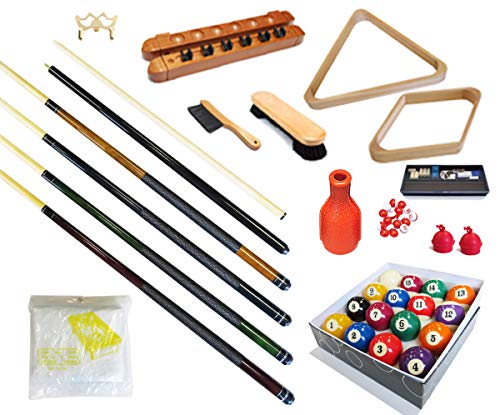
If you have a pool table then you need to get this accessory kit. It includes pool cues, extra pool balls, and all the gear you need to keep your pool table in tip-top shape.
If you are tired of your kids (or friends) ruining your good pool cue when they play then having these extra ones will keep that from happening (just be sure to hide your good one!).
Important Parts Of A Pool Cue
A pool cue is made of three important parts. They are the shaft, the butt, and the tip. The shafts are made of hard rock maple wood while butts may be made of ebony, African Blackwood, Zebrawood, snakewood, cocobolo, or bocote.
Hard rock maple is used invariably due to its strength and durability. Butts may even be made of bloodwood, black ash, purpleheart and black maple, or similar exotic woods that make the butt look good and beautiful.
The tip could be said to be the most important part of a pool cue as this is the most functional part of the cue. The tip is the most important part as this is the only part of the cue that touches the cue ball.
Expensive tips are usually made of leather with different hardness. Medium hard is the best for any kind of gameplay. Tips that have been specially made for breaking though are made from hard phenolic resin to execute the most force.
A variation in tip quality can entirely tip the game one way or another.
Other parts of the cue that are important are the ferrules and the forearm. Ferrules sit between the tip and the shaft and are important for protecting the whole of the shaft from outer and inner damage.
Without good ferrules made out of high-impact resin or carbon fiber, expensive pool cues will not last very long. This is because they need the particular function of absorbing the impact from the cue tip.
The forearm of the pool cue is more a matter of decoration with inlays of different materials that give a cue its distinctive look after all. A forearm may be adorned with Pink Asian coral, blue sapphire, cobalt, turquoise, pearls, blue denim, colored urethanes, and pewter as well as brass.
The more expensive the cue will be the more intricate the inlays on the forearm and butt of the shaft will be.
Then there is the matter of the low-deflection shaft. Most of the high-end pool cues will have a low-deflection shaft as they are better to use as attested by professionals and beginners alike.
Low deflection shafts have a more accurate ability to hold in the angle change on the cue ball due to the force or use of the pool cue. They are able to lessen the impact of the unrequired angle change due to the pool cue.
Last but not least comes the wraps. The wraps are the material in which the pool cues are packed in delicately for travel. Usually made out of leather, they can be made out of snake leather, elephant ear leather, gator leather, chocolate leather, lizard leather, taupe leather, and even more.
This is entirely up to the design of the person buying the cue and what they want it to look like and be made from.
What Is The Game Of Pool?
Pool is one of the classifications of cue sports where there are six pockets within the rails. The object of the game is to use the balls to fill up the pockets after appropriate strikes with a cue.
There are 16 balls in total including the cue ball. That makes for 15 target balls and one ball (the cue ball) to hit those 15 balls into the pockets.
Pool has been in existence for centuries with very strict rules. Pool recently began branching off into different kinds of pool games with varied restrictions and sets of rules to follow.
Pool is a rather tricky game and all the components of the game are made by the table. The table has to be completely level. The pool cue is made with different variations and ornaments.
Lastly, the balls with which to score the game. Outside of the pool table itself, the pool cues are the most expensive part of the game. Pool cues may be as expensive as $100,000 or as little as $100. It all depends on the pool cues design and if they have ever been used.
Conclusion
Now that you know why pool cues are so expensive, you can decide for yourself what pool cue you are interested in, and which one will work best for you.
You can also purchase a cheaper pool cue if you are just playing at your house and you are in need of some cheap pool cues. They will still be sturdy, but not the professional quality cues.
If you are looking for a middle-of-the-road cue stick, then you can purchase those as well. They will have a lot of the higher quality materials, but will not quite be the same quality as the cues that a professional uses.
No matter what pool cue you have, the important thing is to have fun and enjoy playing the game.