
*This post may contain affiliate links. As an Amazon Associate we earn from qualifying purchases.
Have you ever wondered why most pool tables that you come across are green? Maybe you have seen some tables that were not green, and you wondered if green was just cheap? Well, in this article we will go over everything you need to know about pool and and why the tables are green.
So why are pool tables green?
Although pool tables did initially start with a blue covering for almost 100 years, today the green felt is more durable and is cheaper to produce. This makes the game more enjoyable as the balls glide better, as well as the felt is cheaper which makes the end cost of the pool table to you cheaper as well.
If you want to know more about pool tables and why they are green, you will want to keep reading this article. You can also watch this short video to learn about pool table felt.
If you are looking to get better at playing pool one of the best ways to do that is by upgrading your pool cue. One of my favorite cues is the Viking Valhalla. It is available in a variety of colors and won’t break the bank. You can find it by clicking here.
What does history say about pool table color?
According to Historians, billiards are from a line of outdoor games that involve the use of balls and sticks. They are just like the croquet, where a stick propels a ball around and through some pegs and arches. Nobles and royalties were the first to have played the game. Nobles thought that it would be better if it were moved indoors. An explanation to this is that moving inwards protected the nobles from harsh climatic weather conditions and hostile locals.
Over time, the game evolved with the addition of pockets and rubber bumpers on the game table. The games then became an indoor game, and green was used as a tablecloth to imitate the vegetative color of outdoor playing. The green cloth covering has since remained constant as a sentimental nod mimicking the original vegetative playing field.
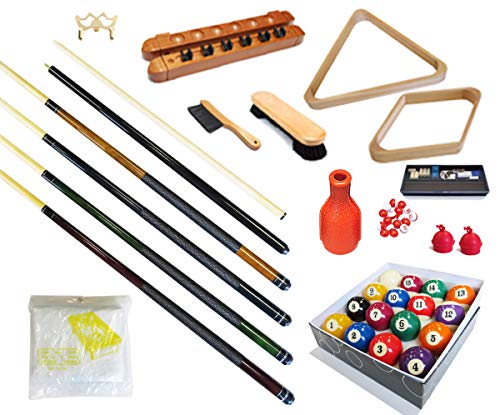
If you have a pool table then you need to get this accessory kit. It includes pool cues, extra pool balls, and all the gear you need to keep your pool table in tip-top shape.
If you are tired of your kids (or friends) ruining your good pool cue when they play then having these extra ones will keep that from happening (just be sure to hide your good one!).
What do the statistics say about pool felt?
According to statistical data from different billiard forums, green pool table cloths were the most popularly used for pool table clothing. The green pool table clothing has a 61% coverage when compared to other pool table clothes like blue and red. Blue has a 38% while red has 1%. Also, a report from a famous anonymous player in the world is said to have had extensive experience in making shots on tan, green, maroon, red, gray, and blue. The player ranks the colors in the order of preference in a descending manner, and it is as follows: Green pool table cloth, tan pool table cloth, blue pool table cloth, grey pool table cloth, maroon pool table cloth, then the red pool table cloth. These colors were according to his overall playability and feel.
What do pool coaches say about the color?
Pool game experts say that the green pool table cloth is mostly preferred. During national or worldwide tournaments, this type of pool table cloth is used. These pool coaches also say that the advantages of the fabric are enormous and cannot be compared with any other color. Finally, they also say that most pool gamers have an attraction to the green pool table cloth, and the color helps them to perform better. With the advantage of the green color, you will understand better why pool table cloths have remained to be green for quite a long time.
Advantages of the Green Color
The green color has more benefits than any other color that is around.
- Appealing
it simply looks nice when it is on the pool table. The green color is attractive, and when in contact with the pool balls, the overall picture is appealing. Also, this green color goes pleasantly with any color of pool tables.
- Better gameplay
When the standard green color is used as the pool table cloth, there will be known differences in the pool game. You will probably experience better gameplay. If you are planning to purchase a home pool table or change your pool table’s cloth, most people choose to go for the green color. Some people today prefer to have the color of the felt match their home, or the room that it is in, so it is available in many other colors.
- It brings light to the game
The green color appears to give the pool table a lighter feel. This means that the green color has a smooth, soothing feel on the eyes and the environment. While playing, this color brightens up the room. You will always want to beware of dark colored felts. They make the room appear dark and dull. On extreme occasions, having a very bright colored material may give some player headaches. This is another reason most people will just keep the green on their table.
- Supporting tradition
As we have seen, green has been the traditional color for decades now. When watching televised tournaments, you are likely to see the green color more on the pool tables and not any other color. Also, for most people, when the pool table is mentioned, the first thing that comes to their mind is a green pool table. One reason why the green color has greatly been used over the last decades is that pool players appreciate tradition, and they do their best to support this.
- Excellent visibility
The green color has excellent visibility. It brings life and light to the game. The lighting effect caused by the green pool table cloth is what improves visibility. In turn, the player can focus on the shots while playing and make plenty of good shots.
- It has a competitive advantage
Although some people may argue this point, if you use standard green felt, it will make a difference in your game. If you get a drastic color like red, you will notice that for some reason you are just not playing your best game. This is true no matter what type of player you are and how long you have been playing.
If you plan on playing on other tables, I would suggest not going to a colored cloth on your home billiard room table. Going from one color to another could have its difficulties. You would not want to be extremely good on a red table and then play at a tournament which has green and be thrown off by the color of the table. No matter how little it may affect you, it will probably still affect the way you play.
Conclusion
Now that you know why pool tables are green and the advantages of it, you can be sure to make sure that your next pool table that you buy has a green felt. There are many advantages to the green felt as we have discussed above, but probably the most notable one is the simple fact that it is what is on almost every pool table all over the world. Green has been the choice of many people all over the world, and even though you can get a different color, you may want to rethink the downside of that different color before you make the purchase.
If you are looking for a different color for your pool table though, this is the best place to get one. They are a good price, and they have many different options to choose from.