
*This post may contain affiliate links. As an Amazon Associate we earn from qualifying purchases.
In the 1990s, Sega Genesis and Nintendo had stiff competition. It was during this time that hundreds of great games were released. Sega games have become highly collectible, steadily gaining in value and rarity.
As it battled with Nintendo for exclusive games, the Sega Genesis produced some of the most memorable titles of the decade.
So Why Are Sega Genesis Games So Expensive?
There are many different reasons why Sega Genesis games are expensive. At one point, the Sega Genesis games were rare and scarce on the market, making them collectible. As with any collectible item, the more the game is sought after, the higher the price goes.
If you would like to know more about why Sega Genesis games are so expensive, please keep reading or check out this video!
Are you a huge Sega fan? Then you have to check out the amazing Sonic and Sega gear that you can get. Whether you want a Sonic wallet, a Sega sweatshirt, or a classic hat there are plenty of choices to choose from. You can find them all by clicking here.
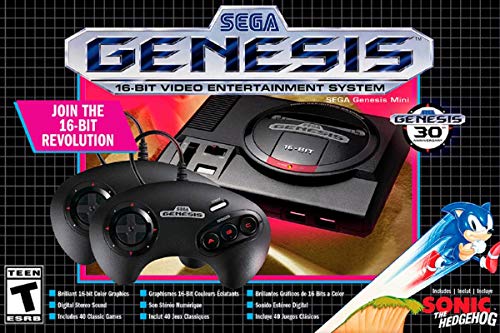
If you love Sega then you will want to check out this Sega Genesis Mini console. It comes with two controllers and even comes preloaded with 42 Games!
Enjoy these classic Sega Genesis games without having to purchase a single game cartridge!
Sega Economics
Boasting a superior sound card and a miniature version of Sega’s system 16 arcade board, Sega proudly touted the Genesis with the slogan: Genesis does what Nintendon’t.
The law of economics states when the supply is low and demand is high, the price goes up, and when the demand is low and the supply is high the price goes down. For the Sega Genesis games, at a certain point they were rare and scarce in the market making them expensive.
The prices for some of the better Saturn games are unfortunately astronomical but you should keep in mind that the Saturn was not that generation’s Genesis for Sega; It went supported for hardly four years – and I even recall reading magazines as both staff and gamers were upset about Sega pulling the plug around ’98 just as some of the later acclaimed games were finally being released..
As it was presented to me, the Sega Genesis is more of a ‘collector’s console’ on top of being within the ‘retro gaming bubble.’
So the prices are not too great, but if you are a collector, it will be worth the cost. So either save your work money, rob a bank or marry a rich person.
Sega Games
Since the year Sega Genesis games were released, they have become highly collectible, steadily increasing in value and rarity. To make sense of what’s rare and what’s not, a list of the most expensive Sega Genesis games was developed.
For each game listed below, extensive research has been done and the games ranked based on their estimated retail value in complete in-box condition. These are the top 12 priced games:
Tetris $20,000: it’s the most popular video game and the most expensive game in existence. Sega was forced to produce Tetris cartridges and scrap what remained from the assembly line.
Outback Joey $10,000: it was Sega’s attempt to enter the fitness market.
Blockbuster World Championship Two $2500: it was a promotional game developed by acclaim. The intentions were to distribute blockbusters around the country for an in store gaming contest but it failed. Destruction of existing cartridges was ordered but a few managed to survive. The game is now a hot collector’s item.
Eliminate Down $1000: is a side scrolling shooter developed for the Sega mega drive. Take command of the steel pylon starship and use your entire arsenal to fight back the Amuleto invaders. It’s a highly collectible title.
Panorama Cotton Set $900: an accompanying panorama cotton tea cup that was given to game owners who sent a special voucher in to sun soft the game’s publisher made it expensive.
Acclaim Games $800: it’s more a collection of games than a single title. The English versions of these games are in high supply, Japanese copies for the mega drive are much rarer.
Battle Mania 2 $600: the game was well-loved in japan due to its exciting jetpack-fueled gameplay and cute anime characters. Combined with its controlled release makes it a highly valuable Sega.
Phantom 2040 Collector’s Edition $600: this particular version was only sold in Australia and it came with a collectable set of stickers as well as a special phantom key ring.
Fatal Fury 2 $550: it’s worth big bucks. It’s largely due to Final Fury 2’s thrilling gameplay, excellent 16 bit graphics and immersive story.
Alien Soldier $500: it’s largely because its endearing side scrolling and run gun mechanics as well as its challenging gameplay.
Mega man $500: this version combines the first three mega man games with additional game mode featuring new enemies and challenging boss level. Its popularity makes it expensive.
Musha $500: combined with its exciting games play and near cult like following, musha is one of the valuable Sega Genesis games in the US market.
Rare and expensive Sega genesis games
Some of these games have become rare collectables and expensive in some scenarios. Check the list below of the rarest and most expensive Sega games:
Beggar prince: the demand for these copies was so high even the developer managed to sell 1500 copies. More copies are yet to be released. If strong demand keeps up there are high chances it will be re-released again.
Bible Adventures: it’s a Christian video game from the wisdom tree. You could not found Bible adventures being sold in video game store. The only place you could found it is at Christian bookstore. When it was released many gamers never knew it existed. This rarity adds to the demand for the game among collectors.
Spiritual Warfare: it’s another Christian video game released by Wisdom Tree. Spiritual Warfare was not also sold in video game store but only through Christian bookstores.
The Punisher: the Sega Genesis was the only home console to receive this game.
Sparkster: the game is a 2D platformer and continues the plot of the original game. The SNES game does not use the same plot line. The sparkster is a well made game and rare. There two factors increase the value of the game.
Where can I find these rare games?
If you are looking to purchase one of these weird games, you will have the most luck shopping on eBay. If you do not want to pay full price for the items, you may want to try looking on local websites such as craigslist and Facebook marketplace.
If you have more time on your hands though and you want to take it a step further you can also look at Goodwill, thrift stores, as well as garage sales and yard sales. These places will be your best bet to find an item that the seller has no idea the value of.
Many people even make a living by doing this sort of thing with various items. So although you may think that it is impossible to find an item that is valuable at one of these places, it actually is highly probable.
If you’re looking to buy these as a collectors item though and you’re ok paying the price that they are for sale then you’ll want to check your local eBay listings. You may also find them at pawn shops as well as collectors websites and swap meets.
Many people will purchase these games knowing that they will only increase in price as they are not being produced anymore.
Conclusion
There are many different reasons why Sega Genesis games are expensive. At one point, the Sega Genesis games were rare and scarce in the market, making them collectible. As with any collectible item, the more the game is sought after, the higher the price goes.
Sega games are expensive due to their rarity. Once you find a copy of the listed above you will want to hold onto it making sure it does not get damaged as it will only rise in value.