
*This post may contain affiliate links. As an Amazon Associate we earn from qualifying purchases.
Have you ever wondered why Donkey Kong has a tie? Maybe you were playing one of the Donkey Kong games and noticed that other characters in the game wear different clothes, but Donkey Kong himself only wears a tie. Well in this article we will go over why Donkey Kong has a tie.
So why does Donkey Kong have a tie?
When Donkey Kong was first created, he was known as a bad guy. As he became more popular, Nintendo wanted him to be friendly and respected and so they added the red tie so he was seen more as a human than a ferocious beast.
If you want to know more about why Donkey Kong has a tie, you will want to continue reading this article. You can also watch this video to find out how realistic Donkey Kong actually is.
Are you a huge Nintendo fan? Then you have to check out the Mario and Nintendo gear that you can get. Whether you want a Mario wallet, a Nintendo sweatshirt, or a classic NES hat there are plenty of choices to choose from. You can find them all by clicking here.
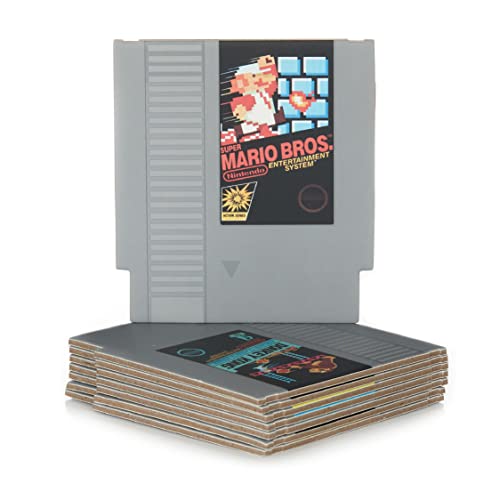
Do you love Nintendo? Then you have to check out this amazon NES cartridge drink coaster set!
This set includes 8 double sides drink coasters that look just like the classic NES cartridges.
This set is a perfect gift for the gamer in your life!
Donkey Kong’s Appearance
Donkey Kong or DK, is a loved video game character created by Shigeru Miyamoto. He is a big ape gorilla living on Kong island with his Kong family. Donkey Kong has been developed by Nintendo and has appeared in many video games. Donkey Kong has appeared in the Donkey Kong game as the main character which became a huge hit.
His physical appearance includes distinct heavy brows and a peaked lock of hair on top of his head Donkey Kong’s clothing style is kept at the minimum. He doesn’t have anything to wear and is naked in most of the games but in some of the Donkey Kong games, he is shown wearing a red tie which has become his trademark.
The Reason Behind Donkey Kong’s Tie
The trademark tie came into existence from the 1994 game, which was the Game Boy version of Donkey Kong, where he again portrayed the lead character after playing some side characters in the recent Mario series. It is in the Game Boy version of Donkey Kong that he resigned and appeared with a red tie, which became his trademark and continues to be there still to this day. DK, his initials are marked on the tie.
When Donkey Kong first made his first appearance, in his signature video game Donkey Kong, he didn’t have any special clothing style. He didn’t have any tie either. Everything was kept simple as in that arcade era it was not a very good idea to give a proper tie to the character as it would unnecessarily make the graphics look more messy.For this reason, Donkey Kong was fully naked in his first show.
After the game, the next video game in the series was based on Mario, the plumber. The next few games focused more on Mario, and Donkey Kong mainly provided side roles. Even though in this game Donkey Kong was a side role, fans had taken quite a liking to Donkey Kong for many different reasons. One reason being the fact that Donkey Kong reminded them of King Kong, as the Donkey Kong game had a lot in common with King Kong.
In fact, Shigeru Miyamoto, creator of Donkey Kong, himself mentioned that he was inspired by King Kong to an extent. Apart from that, past experience has shown that humans have always liked non human characters in different movies and games. Some examples are Godzilla, King Kong, Pac-man or Garfield. There has always been a soft spot for superhero creatures, and Donkey Kong was no expectation. So, Nintendo could not ignore Donkey Kong’s popularity, and this is what brought us the 1994 Game Boy version of Donkey Kong. So with this came the idea of reintroducing Donkey Kong with his new look and what would become his signature tie.
Where did the tie come from?
Donkey Kong was not a human so, even with all the popularity he had, it was important to make him more relatable to ordinary gamers. This was because in the original version of the game, Donkey Kong had actually kidnapped a girl and he was somewhat of a villainous character. Also, normal people loved their heroes to be always good, morally correct, humble and helping. This is where the concept of the tie came from.
The creators wanted a hero who would be responsible, kind, big hearted, loyal and yet very powerful protecting others in help. They wanted an avatar which would roll each and every idea of these into one character. A tie was the best symbol one could come up with. It had everything rolled into one. Someone wearing a tie, goes to the office taking the responsibility of his entire family, protecting them from everything. This tie was used to show that he was always ready to help his family, friends, and fellow workers when they are in trouble.
In short, a tie represented everything the creators of Donkey Kong were going for. So, a tie became an important part of Donkey Kong’s appearance. The necktie was a far cry from the reckless, unruly, wild, untamed and furious character that he was known for originally. This idea of creating a symbol to signify a specific side of a hero has been a choice in Nintendo. Other examples like Mario and Luigi whose outfits were created in a manner to distinguish with their social background. While Donkey Kong was first portrayed like a savage animal, without any social traits at all, the presence of the tie came as a huge success and immediately put him to a different status altogether where everybody could look to and respect him.
The History of The Tie Itself
The color of the tie and the color of the signature embedded in the tie has its own history. Donkey Kong’s tie is red in color and this color too has become one of his trademarks. The red color stands for sacrifice, passion, and strength in Japan. A color which signifies respect and power. The red color is also thought to bring good luck in Japan and is a favorable color. Indeed many popular people could be seen wearing red ties on many occasions.
The reason that Nintendo chose the color red makes perfect sense knowing what the color red stands for, and why they chose red to be the color of Donkey Kong’s tie. This explains why the tie is pretty important to Donkey Kong. The tie signifies everything the creators of Donkey Kong wanted Donkey Kong’s character to be. The tie is identified as the respect that comes with being a superhero.
Conclusion
When Donkey Kong was first created he was known as a rival character or villain. As Donkey Kong became more popular, Nintendo decided they wanted Donkey Kong to not be known as the bad guy. They wanted him to be a respected character who is civilized, and also a hero.
This is why Donkey Kong was given his signature red tie. The tie helped gamers see him as a more friendly and respected character. This change in the character and the evolution of the story seems to be an important factor in the everlasting popularity of this very friendly ape who has entertained us for more than two decades.