
*This post may contain affiliate links. As an Amazon Associate we earn from qualifying purchases.
The Game Boy is an 8-bit handheld game console developed and manufactured by Nintendo. It was Nintendo’s second handheld game console.
The Game Boy combines features from both the NES home system and Game & Watch hardware. The console features a dull green dot-matrix screen with adjustable contrast dial, five control buttons (a directional pad, two game buttons, and “start” and “select”), a single speaker with adjustable volume dial, and, like its rivals, uses cartridges as physical media for games.
So why does my Game Boy game keep freezing?
Some of the most common reasons why your Game Boy might be freezing are:
- The batteries need replaced
- An issue with the game
- An issue with the Game Boy itself.
Unfortunately there can be a variety of reasons why your Game Boy games might be freezing. So if you want to know more about why your Game Boy game keeps freezing, you will want to keep reading or check out this video!
Are you a huge Nintendo fan? Then you have to check out the Mario and Nintendo gear that you can get. Whether you want a Mario wallet, a Nintendo sweatshirt, or a classic NES hat there are plenty of choices to choose from. You can find them all by clicking here.
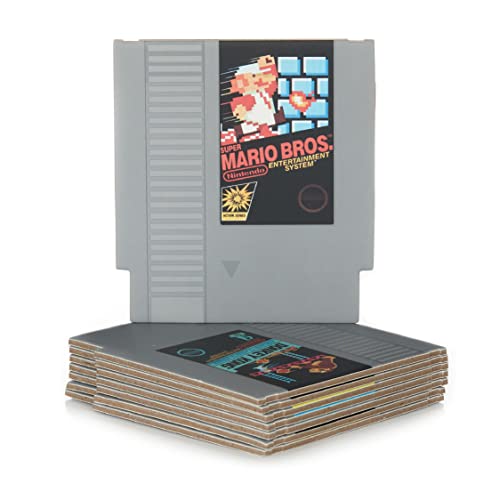
Do you love Nintendo? Then you have to check out this amazon NES cartridge drink coaster set!
This set includes 8 double sides drink coasters that look just like the classic NES cartridges.
This set is a perfect gift for the gamer in your life!
4 Things To Check If Your Game Boy Freezes
There are many different reasons why your handheld Game Boy might be freezing when you are trying to play a game on it. In this section I will give you the most common things that you should check first to see if that fixes the freezing that you are experiencing.
1. Perform A Game Boy System Check
If the game isn’t working on your Game Boy, but is working on some other device, then there is a problem with your console. But, if the problem continues to come up on all the devices, then you can send in the game to Nintendo, and they will repair it for you if it originally came from Nintendo.
If the problem is coming up with every single game you try, then you need to send the system to Nintendo for the repair because you can’t repair everything at your house.
Note* You will only get the replacement from Nintendo if that game originated directly from Nintendo.
If you are experiencing a lag, or the game is still freezing, then you will have to dig a little bit deeper into the Game Boy or take it somewhere to be repaired.
2. Fixing The Game Boy Game
If your game is freezing time and again and isn’t working properly, then you have to hold the power-off button for 10 seconds and then turn the system back on.
If the system only freezes when playing a specific game, then you should contact the game provider and ask them to replace/fix the problem for you.
3. Check The Game Boy Batteries
If your Game Boy game freezes during play, the first step would be to check the batteries. If you use rechargeable batteries or a battery set or power pack from a third-party manufacturer, you should first test the device using new, normal disposable batteries.
If possible, you should check whether the game runs properly on another Game Boy Advance.
4. Change The Game Boy Game Battery
Here’s the list of things you’ll be needing for this fabulous life-saving project:
- The game
- A game system with an open back that can play GB games
The reason for the open back is so you have room to work on the game. I’d recommend either an original GBA or an SP if you have one, but if not then use the GB or GBC.
- The new battery
GB games take CR2025, but some say you can use other sizes. Also, it appears that the manufacturers use Maxell batteries because they seem to last the longest.
- Pair of small needle-nosed pliers
This is for opening the game cartridge and other things, but if you have the bit that can open the game, then by all means use that!
- Some flathead screwdrivers and possibly some picking tools
These are mostly for prying the manufactured battery off the prongs that hold it in.
- Soldering iron & some solder
This is just in case the prongs that hold in the battery pop off, and also if you want to solder the battery in instead of taping it in. If you do, get a soft solder so it’s easy to melt and break for later changing (in about 9 years).
- Some non-conductive tape
This is if you prefer to hold the battery in with tape and don’t want to risk the possibility of messing up something with the solder. It’s also for covering metal tools.
- Common sense
This is a must!
Quick Check Before Getting Started
It’s always a good idea to take the game and make sure it still has your saves. So put it in and boot it up
Opening the Cartridge
Okay, this is the easy part. First get your cartridge and flip it over. Grab your needle-nose pliers (or your screwdriver with the special bit in it) and as gently as possible remove the screw without stripping it.
For those of you who don’t know what that means, stripping a screw is when you repeatedly chip away the metal on the screw head, making it almost impossible to use it again. For example, if you had a phillips head screw (a plus-shaped indent) and the head was strippied, the indent would look more like a square than a philips head; making it hard to use it again.
Now these things are a bit weird. You can’t just pull it off after you unscrew it. You need to flip it back over and take the cover and pull down, then off. And viola! ‘Tis open! And low and behold, there is the doomed battery!
Prepping & Loading the Game
For this step, you will need the game system of your choice and the opened game cartridge.
Take the cartridge (with the back and board together) and put it in the slot of the GBA (or whatever you’re using). Be gentle with it and turn the system on. Make sure the game loads smoothly and no freezing occurs. If it won’t load at first, jiggle it a little. It shouldn’t be an issue though, and if it is, you may be in for a really tough time trying to save that savestate.
The reason for this part is because the battery in the cartridge is what keeps the savestate and (in the Pokemon games) the clock going. If the battery is unplugged or dies, the savestate stored in the SRAM (which is the game’s memory) will be deleted. To circumvent that, we plug the game into the system and turn it on. This gives power to the board and allows us to remove the battery without the SRAM turning off and thus destroying the save file.
I’d recommend booting up the save or going to a place in the game where there is constant music playing without a break. The reason for this is so you know if the game freezes during working on the battery. When it freezes, the music stops or plays a continuous note..
Changing the Game Boy Game Battery
Through this whole procedure, make sure to have a steady grip on the cartridge; making sure it moves as little as possible.
So the manufacturer’s battery has about a total of five solder points. Some older games may have more or less; just be prepared to do some yanking!
To remove the battery, there are several options. You can try to de-solder the battery if you’re confident in your abilities, or you can as gently as possible break the solder with various tools.
Several tips: When dealing with the battery (and no other piece of the board) you can use uncovered tools. However, when you start working on the bottom prong of the battery, use covered tools. When I say covered, I mean putting a layer of tape over the section of the tool that could come in contact with any other part of the board.
The reason being that if at any point you accidentally slip and touch any of the circuits on the board it will short the game and cause it to freeze. Now it won’t destroy the game (unless you actually destroyed the circuit), but if the game does freeze (before you removed the battery) you should be able to just restart it up and continue working.
Just in case you were unaware, the point of this step is to remove the battery with as little destruction as possible. If the prong pops off, no worries! Just solder it back on!
Make sure to continually listen to the game while working to see if it froze. When you finally remove the battery, give it a quick double-check and make sure the game is still on and working. Also, take note as to where the positive and negative go, as you’ll need to put the new battery in the same way.
Putting in the New Battery
Get out the new battery and pop it in there the way the old one went in. You can either solder it in or use tape if you’re afraid to mess things up or are afraid of having to wrestle with the solder the next time you change it.
That shouldn’t be a problem though if you use a soft solder which would be easy to break. You just need something to be able to keep it from moving and keep the contacts on the battery at all times.
If you do solder it in, solder the prongs to the battery, bottom first and then the top. DO NOT SOLDER THE BATTERY TO THE BOARD! Let the solder cool just in case it might burn something. As a side note, these things are pretty resilient.
Putting It Back Together and Running the Final Check
Once you have the battery secured (and are sure that it is), turn off the system and unplug the game. Put the cover back on and screw it back together. Put the game back in, cross your fingers and turn it on.
YAY! You did it! You just changed the battery and kept the save all by yourself and without troubles!
Take a moment to step back and admire your handy work. Bask in the glory, and gloat about your electronics prowess to your fellow cubicle dwellers! Now grab a nice tall glass of lemonade and play that sucker ’til the sun goes down!
Conclusion
So, in this article we’ve given you some ways to troubleshoot your games, and reasons for why your game console isn’t working. Also, information has been given in this article about the reasons why other consoles are freezing, and how to resolve the problem.
If you are encountering issues with every single game that you put into your Gameboy then you will know that there is an issue with the console itself. If only a single game is freezing up then it is an issue with the game.