
*This post may contain affiliate links. As an Amazon Associate we earn from qualifying purchases.
Do you have an NES Classic and want to know if you can play it in Europe? Maybe the system is cheaper in Europe so you want to buy one from there. No matter the reason, you will find your answer in this article.
So will the European NES Classic work in the U.S.?
The good news is that with the release of the NES Classic, Nintendo took away their region lock chip so this one game system could be easily sold around the world. An NES Classic from any area should still work in another area without any issues.
If you want to know mroe about the NES Classic or the original NES and if those are region locked, you will want to keep reading. You can also watch this video which will take you through the good and bads of owning a NES Classic.
Are you a huge Nintendo fan? Then you have to check out the Mario and Nintendo gear that you can get. Whether you want a Mario wallet, a Nintendo sweatshirt, or a classic NES hat there are plenty of choices to choose from. You can find them all by clicking here.
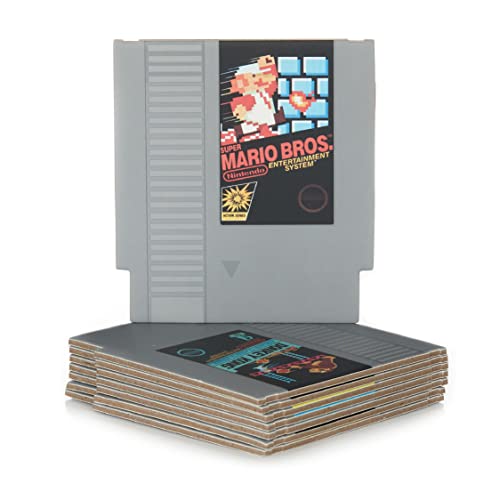
Do you love Nintendo? Then you have to check out this amazon NES cartridge drink coaster set!
This set includes 8 double sides drink coasters that look just like the classic NES cartridges.
This set is a perfect gift for the gamer in your life!
History of the NES
The NES is officially called the Nintendo Entertainment System. The Nintendo Entertainment System (NES) was the world’s best selling gaming console that hooked to your TV. When it was released, it was way ahead of its time as far as the graphics and what the system could do. It was released city by city in 1985 and 1986.
The sales of the original NES went on for a long time, and even to this day they are being sold as collectors items, and played in people’s homes on a daily basis. This system is one of the most loved systems that has ever been created by any gaming company ever!
Because the System was such a big hit, and so many people are still in love with it, Nintedo decided to remake the console. When Nintendo announced they were remaking the console, the gaming community went crazy! Although most of the people in this generation had not played the original Nintendo, they had heard stories. This would be their chance to play the system and finally understand what all the talk was about.
Nintendo released the game on Nintendo 10, 2016. The NES Classic came preloaded with 30 games and originally sold for only $60! Because of the popularity of the original NES and the price point of this system, the opening day turned into a nightmare for many gamers! The stores sold out within minutes, and online sold out within seconds! Tens of thousands of people who even placed their orders online, were refunded and told the item they ordered sold before they placed their order. Many people were very upset that they were not going to get a chance to play their favorite childhood games, or own the NES Classic.
Before Black Friday of 2016, Nintendo said that they were producing more systems, and they would be readily available by Christmas. Finally everyone would be able to own the console! Although Nintendo said they would be available, there were never enough sent to keep up with demand. Because the system was in such high demand, people who had been able to purchase one, began to sell the brand new consoles for almost $300!
Because of short supply, there were alot of knock off NES classics that hit the market. Although these systems looked the same on the outside, they were not made properly on the inside, and a lot of them had issues with controllers, music, and the games working properly. Hundreds of thousands of people had already purchased these systems though before they found out they were not the actual item. If you are looking to purchase the NES Classic, or you think you might have a fake, you will want to watch this video to spot the differences.
Design of the Original NES
When Nintendo designed the NES, they wanted something that was different from what the rest of the world already had. This is where the square boxed look, as well as the plastic cartridges came from. Although people did not know it at the time, anyone who purchased one of these original game systems was buying a piece of history!
The NES was released in the test markets of New York City and Los Angeles in 1985. Nintendo then did a full launch in the remainder of North America and parts of Europe in 1986. It was then released in Australia and the rest of Europe in 1987.
Selling History in the United States
In 1987, the NES turned into the top-selling toy in America, while The Legend of Zelda turned into the primary NES game. Today the Legend of Zelda game is still being played on current consoles, and has over 6.5 million sales! In America alone, the income for Super Mario Bros. 3 was over $500 million with more than 7 million units sold and over 4 million in Japan! In 1991, Nintendo earned about $1.5 million for every one of its 5,000 workers.
Nintendo had such a big following that it literally shaped the American culture! In the mid 1990s Nintendo made more money than the entire american film Industry! A review demonstrated that Mario was more perceived by youngsters at that time than even Mickey Mouse.
In 1991 Nintendo introduced the Super NES! The SNES was a better version of the original NES console in many ways. The first and most obvious way was that the system was a 16 bit system instead of the 8. This meant the graphics were better as well as the gameplay was smoother and the games were more advanced. The second reason was the SNES controller. Contrary to the original NES, the SNES controller was rounded, and had four buttons on the pad as well as two shoulder bumper buttons. This was the first time the shoulder bumper buttons were introduced, and even to this day are being used!
Nintendo’s lockout chip
NES consoles and games sold in various areas of the world have distinctive lockout chips. This is so games that are promoted in one district don’t deal with problems from another. Below are the different regions according to Nintendo.
- USA and Canada
- Europe, Asia, the UK,
- Italy, and Australia.
Since two sorts of lockout chips were discharged in Europe, European NES game boxes frequently have an “A” or “B” letter on the front. This shows whether the game will work with UK/Italian/Australian consoles (A), or the remainder of Europe (B).
Games in the remainder of Europe ordinarily have a message on the container expressing “This game isn’t compatible with the Mattel or NES forms of the Nintendo Entertainment System”. Likewise, UK/Italy/Australia games express “This game is just compatible with the Mattel or NES renditions of the Nintendo Entertainment System”.
Conclusion
The NES classic is such a fun game system! It takes the original NES that everyone loves, and makes it possible for today’s generation to play and learn the original games of Nintendo. If you did not get a chance to purchase one yet, they are still available here. If you love the original NES games, then you are bound to love all of the Nintendo games this device has to offer. So if you are ready to once again enjoy playing the classic games from Nintendo, this system is for you!