
*This post may contain affiliate links. As an Amazon Associate we earn from qualifying purchases.
Do you own a NES Classic and want to know if it will be a collector’s item? Maybe you are looking at buying one and want to know if you should open the box, or leave it boxed up. No matter what you are looking to find out, we will answer these questions as well as a few others in this article!
Will the NES Classic be a collector’s item?
Because of the scarcity of the item, and the price increase that has gone on since 2016 when they first released, we do expect that they will be a collector’s item at some time in the future. Of course that could change if Nintendo decides to release the system again in the future.
If you have one of these systems, and you have more questions you will want to keep reading this article.
Are you a huge Nintendo fan? Then you have to check out the Mario and Nintendo gear that you can get. Whether you want a Mario wallet, a Nintendo sweatshirt, or a classic NES hat there are plenty of choices to choose from. You can find them all by clicking here.
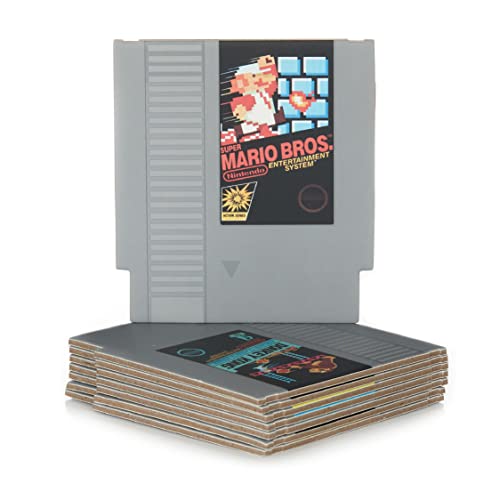
Do you love Nintendo? Then you have to check out this amazon NES cartridge drink coaster set!
This set includes 8 double sides drink coasters that look just like the classic NES cartridges.
This set is a perfect gift for the gamer in your life!
The NES Classic
The Nintendo Entertainment System is still a console of choice for a lot of people today. It is because of the retro games it offers that has filled the gap of the past decades. We believe it will become a part of a collector’s item because of the games it offered, simplicity, ease of use, and connectivity.
Nintendo recently announced that they are going to discontinue the NES Classic in 2019. This came as big news for the fans as they had just started to get their hands on this console.
Nintendo Entertainment System is in high demand all over the world. People want to make it a part of their collection because it is so hard to find. It offers games such as Mario Bros, Mario Bros 2, Mario Bros 3, Pac-Man, Donkey Kong, and many more. These games are considered as the best classic games of all time!
Why is there a possibility of it becoming a Collector’s Item?
It has been said that the things that have become a part of collector’s items are the ones that are rarely available in the market. Because of its scarcity, there is more demand by the people, and real collectors want to make an item like that an inevitable part of their assortment.
Why will it be a collector’s item?
We believe Nintendo will remain as a part of the collector’s items, because of the elegant and sleek design of the console, the retro-fashioned consoles, the games, and the simple user interface.
How much does an NES Classic cost?
Although the Nintendo Entertainment Console was available at a reasonable price of $60 when it first released, it is now over $120 and climbing. Even at this price through, there is no other console available in the market that offers the same amount of features. If you divide this $120 retail price by the 30 in-built games, each classic and world popular game is available for $4 each, which is still almost nothing. You can even still purchase one here.
Issues with the NES Classic
Although this console has all the elements to make it a dream for an old game player, they offer a few difficulties as well. The games that this console offers are all designed and created in the past, therefore by making them compatible with 720p HDMI display, some sort of lag sometimes happens. Also, the controller to console time is prolonged. This is the time ratio when the controller is pressed to the time when the output and intended action appears on the screen. This is also because of the same previously mentioned compatibility issue.
Another critical problem is the short controller’s cable size. Therefore to play the game, users had to sit so near to the TV or monitor, which can be cumbersome sometimes. The fix for this was to buy an extension cable for the controller available here, or a wireless controller that is available here
Console Design:
NES consoles are available in a white matte color. It has a gloomy and console to box design that looks very solid. Although its size is tiny, which is about the size of the palm of someone’s hand, it offers all the capabilities of old consoles mixed with new.
Side to side comparison with other old consoles
As compared to the old consoles that were way bigger and offered fewer features, this console is a part of the future because of its specifications. Old consoles played games using the game cartridges, but this classic Nintendo console has the games built in. Players do not need to spend money on separate cartridges as all of the best games are already available internally.
Conventionally, old consoles had no features of pausing, resuming, or saving the game. Only a few consoles offered that, and only at one certain point in the game. The Nintendo Classic changed this concept by bringing these options to their console.
The games can be started, paused, resumed, and collected at any point in the game you want. There are four slots that you can put a saved game into. Each slot that is available can be used anywhere in the game. This invention means the game will never be lost even when the power is turned off. It can start from the point where it is saved on the slot, so it recommended to users to use these slots wisely.
Software, games, and user interface
The Nintendo Entertainment System uses a very definite and precise front design. Its layout is straightforward. That is why it is easy to follow. Since it is developed to give back the memories of the past, it follows a classic design pattern. The screen option can be adjusted in a way so that the games appear to give the taste of history. However, for new users who want to enjoy those games in bright graphics, the pixel density can be adjusted to get a sharp and bright look.
The console can be connected to a 720p HDMI. This means that the NES has great output, and a great aspect ratio for newer tvs. The pixel ratio in the game can be adjusted by doing the following.
You can also watch this video if you are more of a visual learner.
- From the home menu, go to the menu section at the top of the screen and select the display icon.
- Use the D-pad to highlight the display mode of your choice, then press A to select it.
- Press B to return to the HOME menu.
It offers three display modes which are
- CRT filter
- 4:3 aspect ratio
- Pixel Perfect
The Cathode Ray Tube (CRT) effect adds a traditional TV design so that the memories of the back can be enjoyed. The Nintendo Entertainment System offered the best games of its time, and they want you to be able to play the games just as you remember them if you want!
The front of the console contains small buttons and ports that are compatible with a lot of other equipment. It has an HDMI port, power port, and USB ports. To connect it, plug in the power cable and push the start button on the front of the console.
Conclusion
People only prefer to collect the item that has some value in the marketplace and are limited. Most things that are hard to get fall under the category of a collector’s item. If these Nintendo classic consoles are readily available in the market, everyone would eventually get it and play it, and there will be a time when they’ll get bored with it.
Luckily, these consoles were not produced to the demand of the public by Nintendo, so everyone who owns one, now owns a piece of history, and a collector’s item that everyone wants!