
*This post may contain affiliate links. As an Amazon Associate we earn from qualifying purchases.
When the NES classic was released, there was a lot of hype to build up the game. If you are like me, you don’t just jump at the first thing that comes along. You are patient and want the best deal. So i’m sure you have wondered if the NES Classic will be worth money. Well you are not alone on this question.
So, will the NES Classic be worth money?
Although the NES Classic will in fact be worth money, it may not be as much money as everyone hopes. Unfortunately there is no way to know what the market for this system will do in the future.
If you want to know how much money the NES Classic will be worth, you will want to continue to read this article to have all of your questions answered.
Are you a huge Nintendo fan? Then you have to check out the Mario and Nintendo gear that you can get. Whether you want a Mario wallet, a Nintendo sweatshirt, or a classic NES hat there are plenty of choices to choose from. You can find them all by clicking here.
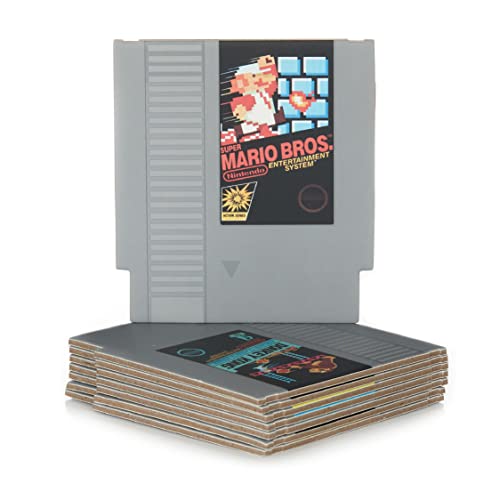
Do you love Nintendo? Then you have to check out this amazon NES cartridge drink coaster set!
This set includes 8 double sides drink coasters that look just like the classic NES cartridges.
This set is a perfect gift for the gamer in your life!
The NES Classic
Nintendo Entertainment System, also known as NES, is the ultimate gaming setup if you want to bring back all the nostalgic memories of your early gaming days. The main reason for this is that it is available at an affordable price. It has tons of built-in games, so you do not need to buy games if you want to enjoy all of the games the NES has to offer.
The games
With the Retro console in a box design, this Nintendo Classic console has come back for the fans so that they can relive all of their memories. It comes at $60, which is pretty affordable if it is compared to other quality consoles in the market. Additionally, the Nintendo fans can enjoy almost all the great games because they are built in the console. The exact game count is 30. If you think about it, you can get 30 of the best classic games and the nes classic console for only $2 a game! That’s a steal for any gamer!
The system
It has matte hardware that provides an abstraction from the sophisticated internal device. Following the pattern of futuristic designs, it trails a minimalistic pattern. Compared to the other consoles, it is tiny in size. Containing a power button, a reset button, an HDMI port, and a USB port, it provides convenience because all the devices support it.
The controllers
These follow the same design pattern of the original controllers of the original NES. They can be plugged-in to the USB ports and can be used on the go. Unlike the designs of the new age console, this Nintendo Classic’s controller follows a rectangular configuration. Although it is connected with the USB plug, you can also purchase wireless controllers as the cords for the console are extremely short.
Like every controller, it has up, down, left, and right keys, as well as the keys from which different options of the game will be selected. Along with these features, the select and start button as well that can be used to select and start the items on the screen. It is still the two button controller same as the original controller as well.
A simple piece of equipment
Nintendo Entertainment Classic Console is considered as a simple piece of equipment. The reason why is because it offers no internet connection over Wi-Fi or over direct Ethernet cable. Also, there is no slot to input any SD Card. The games can only be played with just the built-in setup. Although it looks bigger in many pictures, it is actually only the size of the palm of a hand. It may not be a big console, but it has the performance and the capacity to play the best retro games ever made!
The console is simple to start and play. In order to play, the first thing you need to do is plug it in. Once it is plugged in, you will plug in the controllers, and then turn on the console. From the simple screen layout, select the menu, game, setting, or instruction option. To turn it off just push the start button on the front of the console, and to pause a game just push the start button on the controller.
Games
The original NES consoles did not have the features to leave the game system on and choose different games to play. This is because they offered minimal features. The NES classic changed this concept in a way that provides this feature. In addition to this feature, the matches can be saved at any point.
From the main menu, all of the games are listed vertically. The games are perfectly aligned so that players can easily select what to play. The user interface is just like the previous one to get a complete experience.
This plug and play consoles include famous games such as Balloon Fight, Bubble Bobble, Castlevania, Donkey Kong, Dr. Mario, Super Mario Bros, Super Mario Bros 2, Super Mario Bros 3, The Legend of Zelda, and many many more great games!
How to save any game where you are
Simply push the reset button on the front of the console. This will create a temporary suspend point that will be saved in the home screen. Once you are on the home menu, simply push down on the D-pad to move the temporary suspension point to an empty save slot and press A. Doing this will save the game exactly where you left off no matter where you were in the game. You only have four slots for the saved locations that can be used at max, so make sure to use them wisely.
An improvement over the existing games
When Nintendo was first released, the games had a lot of glitches. In this Nintendo classic version, these old games have improved a lot. The bad playing quality that was once recorded is now enhanced on this console, and even though the graphic did not change, the slow responses from the controller and glitches in the games were all fixed.
Display Modes
To bring back the memories of childhood, Nintendo has added a lot of nostalgic features to the games so that the games would look original. There are multiple options, such as adjusting the look of the games on the screen. The pixel density of the games can even be set to square so that even the old retro style games can appear new. To take a trip back down memory lane, simply follow these steps!
- From the home menu, go to the menu section at the top of the screen and select the display icon. The display icon on the NES Classic edition.
- Use the D-pad to highlight the display mode of your choice, then press A to select it.
- Press B to return to the home menu.
It offers three display modes which are:
- CRT filter
- 4:3 aspect ratio
- Pixel Perfect
Problems
Although it is one of the best-redeveloped versions of previous consoles, it offers a few disadvantages as well. It has included a lot of the most popular games of its older versions, but not all of them. There are a lot of recognized games that are not available on the console. If the Nintendo fans want to enjoy those, they have to get the separate game and the original console.
One thing that has upset the fans is the input lag. The games are reacting at a prolonged rate to the controllers, which seems to be a significant problem. Also, the length of the controller is super short! Because it is so short most people opted to buy a third party controller extender cord that is available here, or a wireless controller that is available here
Conclusion
The Nintendo Entertainment System offers the best selling games that are available at all packed into a very inexpensive game system. It can be used as a present for your kids, or maybe for the kid inside of you. Either way, you can purchase the NES Classic console here.