
*This post may contain affiliate links. As an Amazon Associate we earn from qualifying purchases.
Have you ever wanted to play your Sega Genesis, but you weren’t sure if it would work on the newer TVs or exactly how to connect it? Maybe you have new HDTVs and you want to know what you need to play your Sega Genesis on it?
Well, in this article we will go over everything you need to know about the Sega Genesis and if it will work on an HDTV as well as the different options that you have for connecting it to modern flat-screen TVs.
So will the Sega Genesis work on HDTV and how can it connect to it?
The Sega Genesis will work on an HDTV or any modern TV. There are three basic ways to connect your Sega Genesis to your HDTV and they include an RF cord, composite RCA cords, as well as HDMI. Most HDTVs use HDMI to connect to the Sega Genesis.
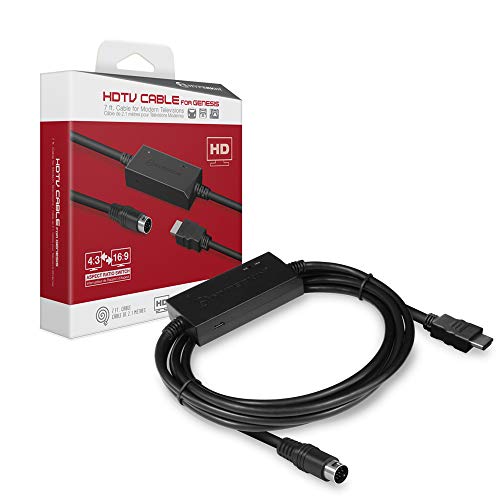
I will go into detail about how to connect your Sega Genesis to a modern smart TV in the next section. If you are going to connect your Sega Genesis with an HDMI cable, you will need to purchase this adapter. There is no need to worry though as the adapter is not that expensive.
If you want to know more about connecting your Sega Genesis to your HDTV, you will want to keep reading this article. You can also check out this video to learn how to connect to the HDTV.
Are you a huge Sega fan? Then you have to check out the amazing Sonic and Sega gear that you can get. Whether you want a Sonic wallet, a Sega sweatshirt, or a classic hat there are plenty of choices to choose from. You can find them all by clicking here.
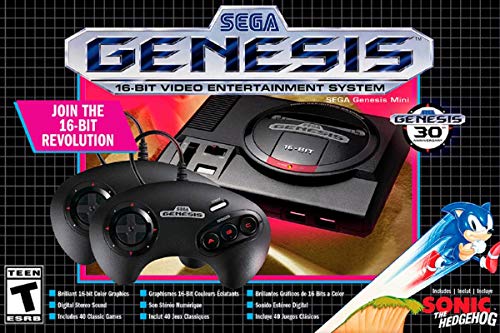
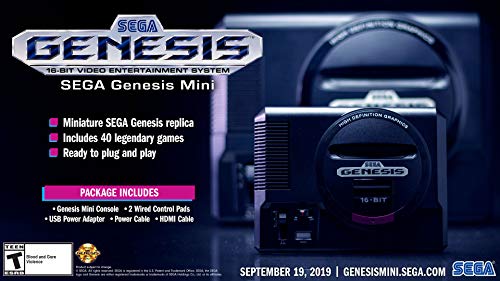
If you love Sega then you will want to check out this Sega Genesis Mini console. It comes with two controllers and even comes preloaded with 42 Games!
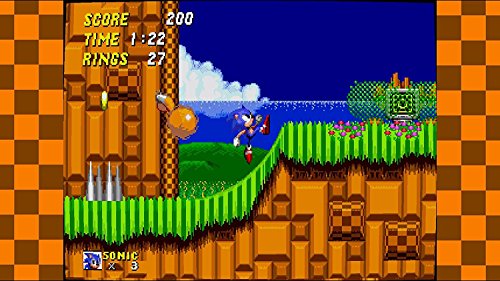
Enjoy these classic Sega Genesis games without having to purchase a single game cartridge!
3 Ways To Connect The Sega Genesis To TV
RF cable: This cable is included with the Sega Genesis, but the quality of the picture is horrible. It should be the only option if your television doesn’t have an RCA port available.
Composite RCA: It provides a good picture quality from the Sega Genesis. Compared with RF this one is much better
HDMI: This is the most recent one in the market, and is the best option for new flat-screen TVs.
Below we will go over everyone and show you exactly how to make them work with your system.
1. RF TV Connection For The Sega Genesis
If you were born before the 80s, you would remember this method. It was the staple method of hooking game systems to the TV, starting with Pong. It’s the worst way for the picture quality but it was all that the systems had.
All the video and audio signals are compressed into one coaxial cable and jammed into the TV, letting the television split apart on its end. This leads to a fuzzy picture and is often accompanied by rolling lines.
Step one: Plug the Sega RF box into your Sega Genesis. Use the cable with the end that plugs in.
Step two: Attach the other end of the Sega RF box to your television cable part.
Step three: Change the CH3-CH4 switch to the desired channel. On your TV’s inputs, this is typically referred to as air.
Step four: plug the Sega MK -2103 power source into the back of the Sega genesis.
Step five: plug the Sega MK-2103 power source into the wall
Step six: Put in the game and turn on Sega Genesis, even if you don’t see it on TV yet. You should see the power light on the Sega Genesis fire up, and doing this first will assist in getting the TV settings when you are searching for the right channel.
Step seven: Turn the TV to the station you choose on the back of the game system. If everything went right and your game works, then you can begin playing on your console.
2. RCA TV Connection For The Sega Genesis
This is a method that will give you a better picture quality from Sega Genesis on classic CRT or tube TVs. Consider this method whenever possible since it has improved image quality over the RF connection is very noticeable
Step one: place the Sega Genesis model 2 RCA AV cable into your Sega Genesis.
Step two: join the other end of the RCA cable to your TV. Always use the yellow port for video.
Step three: Plug the Sega 2103 power source into the Sega Genesis.
Step four: Plug the Sega 2103 power supply into the partition.
Step five: Plug in a game and turn on the game system even if you don’t see it on TV yet. When you are searching for the right channel, and you know the game, then you got it right.
Step six: Turn your TV to the appropriate video source. To change from different video signal options, you usually have an input button on your remote or television.
Step seven: Enjoy some of the games you remember from years gone by.
3. HDMI TV Connection For The Sega Genesis
The third way to connect your Sega Genesis to your modern TV is through HDMI. Now I’m sure that you have looked at your Sega console and know for a fact that it does not have an HDMI output… and you would be correct.
However, there are many companies that sell an adapter that is designed to go from the video output on the Sega Genesis to an HDMI port on the modern TV.
As you can see in the picture above this adapter cord is designed to go from the output on your Sega Genesis directly to the HDMI input on the TV. So to use this method all you have to do is simply buy this adapter (you can check the current price here) plug it into the back of your Genesis and the back of your TV and you are ready to play.
This is by far the easiest method to use your Sega Genesis on an HDTV but unfortunately, you have to buy this special cord to be able to do it.
This is the only Sega Genesis cord that you need to connect your console to modern TVs so you don’t have to worry about buying anything else beyond this cable if you want to play your Genesis on a smart TV.
Why Does Your Sega Genesis Look Horrible On An HDTV?
Older game consoles were designed to work with older televisions. Sometimes they will not work right, and below we will go over the reasons why that happens.
1. Resolutions fail to match up.
For example, most of the games on the Super Nintendo Entertainment System use a display resolution of 256*224. Compared to standard 1080 television at 1920*1080, it’s practically a jump from California to New York!
2. They are not supported sometimes
Sometimes 240p signals are not even supported on modern TVs, leaving some entirely incompatible with consoles from the PlayStation era and earlier.
3. Ratio problem
Old TVs were 4:3, while today’s HDTVs are 16:9 widescreen. If you think of displaying an older console on a new TV and it stretches the image to full screen, it will be 1.5 times wider than the usual size. You can set your new TV to the aspect ratio of 4:3 manually.
Another way is to zoom the image, but this will cut off a portion of the top and bottom. Zooming will hide crucial game information like remaining lives or ammunition.
CRT television has fast image processing lower than 3-4 milliseconds. The digital setups on modern TVs and monitors are more complicated and an expensive gaming monitor will have an input lag of around eight milliseconds.
How To Connect Your Old Video Game Consoles To An HDTV
It’s not hard to plug everything in and get your game on, here is how to go about it.
Use a quality connector available for the console
Use the best quality video connector available that is also on your TV. You can only shake when your console uses a connector that is not available on your TV.
1. Connect To The TV Via Composite
Connect your RCA cables to the red and yellow composite video ports on the back of your TV. Older consoles like the Sega Genesis have complete composite video cables with all red, white, and yellow connectors. In case yours has only two connect red to red and try the whiter one, either the white or yellow connector.
2. Use Coax For Older Consoles
If the console you want to connect uses a connector that your TV doesn’t have, you will need a converter that will connect to a port your TV has. The simplest method to do this is to communicate through coax since most modern sets still have one.

Three Ways To Connect Your Sega Saturn To Your Television
- RF: you should use this method if your TV does not have RCA available. This method provides poor picture quality.
- Composite RCA: compared to RF, this is much better. The quality of the picture is good.
- S-video: this provides the best picture quality available from the Sega Saturn. Most gamers recommend the use of this method, if possible.
Conclusion
If you don’t have the right cables to fit the correct port, the best solution is to go and find the right cables for your system. This is going to be the best place to find all of your connection cables.
Bear in mind that different Sega Genesis versions have different video connectors. No matter what version you have though, you can always find your connector at the link above.