
*This post may contain affiliate links. As an Amazon Associate we earn from qualifying purchases.
If you are from the jukebox era or are just interested in getting one for your game room then you are in the right spot! There are tons of jukeboxes to choose from when trying to find one for your home so that is why I decided to write this article.
Hopefully by the end of the article you will have a much better idea of which jukebox will be the best for you.
What are the best jukeboxes for home use? There are basically 4 different types of jukeboxes that you can purchase. Those four types are:
- Tabletop jukeboxes
- Partial size jukeboxes
- Reproduction jukeboxes
- Original jukeboxes
Each of these comes with their own sets of pros and cons which we will mention for each type. We will also give some examples of each type so you can do a little more research on your own.
Do you have a game room in your house and you wish that you had a full-sized jukebox to put into it? Well, you are in luck as you can find a variety of them to choose from by clicking here.
Do you love the thought of a nostalgic jukebox but can’t afford to spend thousands on it?
Then this tabletop jukebox is for you.
Looking and feeling like an old time jukebox but sitting on your counter or table you really can’t go wrong with this one.
Tabletop Jukeboxes Pros & Cons
When you think of jukeboxes you probably think of the full size one that sits in a bar, restaurant, or gaming place. Tabletop (also known as desktop) jukeboxes are like those… but way smaller!
A tabletop jukebox is great for a few reasons:
The Pros
1. They are cheap
One of the biggest downsides to full size jukeboxes is that they are quite expensive. With tabletop jukeboxes you can often get them for under $100 and sometimes even far cheaper than that!
2. They are small
As it says in the name they are designed to sit on top a table or desk. They are lightweight and easy to move around as needed. You aren’t stuck with having your jukebox in one place and not being able to move it because it is too heavy.
3. More features
A desktop jukebox has many more features on it than an original jukebox will. Most desktop jukeboxes have bluetooth capabilities, CD players, AM/FM radio, and more. Some models even have a USB and SD slot for you to play your music that is on those devices!
Of course not everything about desktop jukeboxes is amazing or everyone would own one.
The Cons
1. They are cheap
Yes, I know that’s the same as the pro but hear me out. With electronics (and many other things) you get what you pay for. If you are paying under $50 for a desktop jukebox it is going to be cheaply made with cheap parts and will most likely have horrible sound quality.
Just because something is cheap doesn’t mean that it is really a good deal! Quality is a factor for many people and that is why the other jukebox types are also popular.
2. They are small
The size of a desktop jukebox can be a pro for some people while being a con for others. If you are trying to deck out a game room with all the best games and music from the last century then you will want to have a full size jukebox and not a tiny one.
Having a tiny jukebox in a game room full of pinball machines, arcades games, etc. will just look… sad.
3. They won’t play records
One of the coolest things about jukeboxes is how they play a specific record when you choose it from the selection menu. You lose that part with these players as not only won’t they play records but they are literally just a differently styled stereo.
Not working like an original jukebox is one of the biggest downsides to this type of jukebox.
Now that we’ve covered a few of the pros and cons of the desktop/tabletop jukebox let’s dive into a couple of specific models.
Best Tabletop Jukeboxes
Below are my two favorite tabletop style jukeboxes. I will give both the pros and cons of each of them so you can easily compare the two and decide if this type of jukebox is right for you.
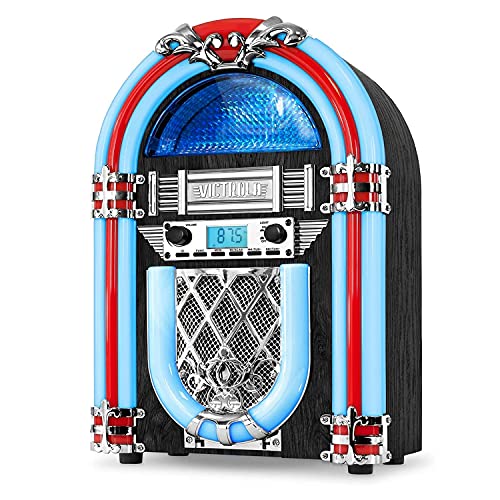
1. Victrola Retro Desktop Jukebox
This jukebox can fit into anyone’s house or apartment. Besides being small in size, it looks exactly like a jukebox you would see in a 50s era in a malt shop or bar. This jukebox can use bluetooth connection from any compatible device to play music. This model stands at 15 inches tall.
Pros:
- Classic old-time dinner style 50s countertop jukebox with real wood veneer.
- Retro color changing LED light tubing in 7 bright colours.
- Can save up to 20 of your favorite FM stations
- Looks quite nice
- You can use the unit with the lights on or off
- Has bluetooth technology to stream music from your phone
- It has an FM radio, CD player, USB, and SD CARD reader.
Cons:
- It’s not advisable to install it next to heat sources.
- The LED tubes are quite fragile so they can get broken during shipping or if it gets knocked over.
- There have been reports of a lot of defective devices out of the box so be sure and purchase from a store with a good return policy.
- The item itself feels very “plastic”.
- If it gets unplugged all of your preset stations get reset
- Speakers are really only “adequate” and don’t have the best sound quality.
If you are interested in learning more or checking out some additional reviews from this item you can find it on Amazon by clicking here.
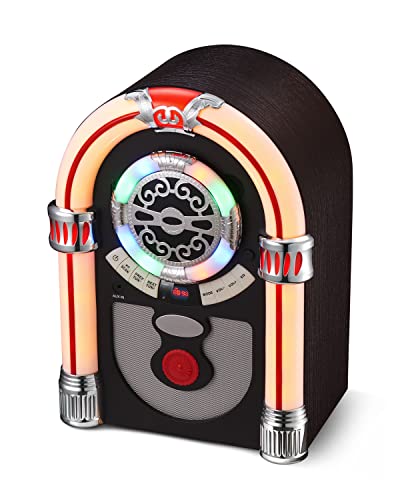
2. UEME Retro Tabletop Jukebox
This tabletop jukebox is again quite small but does a good job for what it is designed for. It has color changing LED lighting and a wooden veneer. This model sits at only 11 inches tall.
Pros:
- Front loading CD player
- No assembly required
- Built in Bluetooth
- Simple controls
- AUX input to play music from all devices
- Decent sound quality
Cons:
- Hard to see the window to know what mode it is on
- FM radio doesn’t work very well
- Not loud enough to use in a busy area of the home
If you are interested in this item you can find it on Amazon here.
Midsize Jukeboxes
This style of jukebox is right in the middle between a desktop size and a full size model. These models work best for game rooms or even a living room where space is at a premium. This style jukebox will be much higher quality than its desktop counterpart but it will also cost quite a bit more.
The Pros
1. The Size
This model will work in many places where a full size jukebox is just a bit too large and overpowering. Most of these models will be around four feet tall which is a foot or foot and a half smaller than a full size one.
2. Cheaper
This style jukebox is considerably cheaper than its full size counterpart with some of these models running half the price of a full size one.
3. Plays records
Once you go from a desktop to a partial size your player will be able to play records! This is great for those who have collections or who just want one device to play their records, CDs, etc. on while still looking nice!
The Cons
1. Quality
Since these style jukeboxes are cheaper and smaller than a full size one you will normally sacrifice a bit of quality. Some models are worse than others but anytime something is half the price of another you will always have a drop in quality.
2. Sound
The sound quality on these middle of the road jukeboxes is as you would expect, middle of the road. You won’t find amazing sounding music here so if that is your goal then steer clear of these medium sized devices.
3. Bad Brands
Many of these style jukeboxes are produced by off brands in China. Sometimes you might get lucky and get one that works entirely. Other times, you will have to return them over and over again to try and get one where all the functions work.
Most of the larger companies make either full size models or desktop but they don’t mess with the middle size.
Best Mid Sized Jukeboxes
As mentioned above there are some pros and cons to these medium sized jukeboxes. Below I will give you my favorite as well as the pros and cons that are specific to this model.
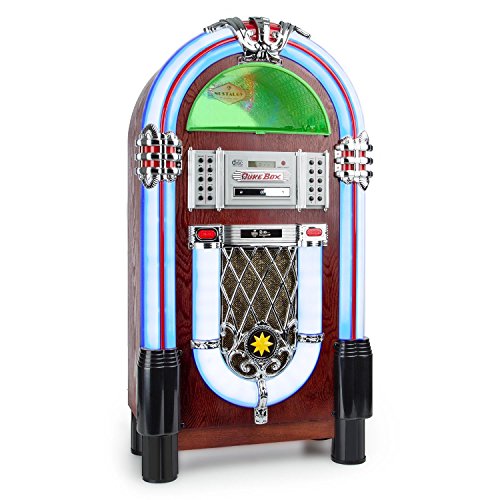
Auna Graceland Jukebox
This jukebox is a good middle of the road option for price as well as size. This player has a lot of features including:
- Record player
- USB
- AUX
- AM/FM Radio
- MP3
- CD player
- Programmable playback
- And more
Pros:
- Has good sound quality with ample bass
- LED lighting looks very nice
- Has tons of great features
Cons:
- Quality of the player is poor
- Record player doesn’t work very well
- Often has issues with the SD and USB reading properly
This model has been a hit or miss for many people so if you get one that doesn’t work properly then send it back and get a new one. You can check out this model on Amazon here.
Reproduction Jukeboxes
Now the real fun begins. These next two sections are for the heavy hitters! These reproduction jukeboxes range in price from around a thousand up to close to $10,000! These models are for the person who has a dedicated room or garage that is decked out with everything retro.
Depending on the cost of the machine you will either get a slightly different reproduction or a virtually identical in every way model. Of course the more expensive the model is the closer that it will work to the original.
The Pros
1. The looks
These models look absolutely amazing and are just like the ones that you remember from many decades ago. They will often look exactly like a specific model from years gone by or they might combine the best parts of multiple models.
2. The sound
Oh yes, when you are spending this kind of money the sound quality will be over the top amazing. You won’t find chincy cheap speakers in these models! You will have some amazing sound quality that does the records and the rest of your music justice.
3. Finishes and Features
What sets these more expensive models apart is that they have high end finishes and the features to match. Some of the cheaper models will have real wood but as you start to get above 2-3k you will notice that the quality goes up dramatically.
At the higher price points you will not only have better quality jukeboxes with more features but the quality of those features will also increase dramatically. You will go from features that kind of work to ones that work flawlessly.
At these higher price points you are really paying for the features and finishes that are over the top and flawless.
The Cons
1. Expensive
These reproduction style jukeboxes can be quite expensive. At the low end they are normally around $1,000-$1,500 but at the high end they can be 8-10k. Now obviously you don’t have to buy the most expensive one on the market but it is quite obvious that these models don’t come cheap.
2. Quality
The quality on some of these cheaper models can be quite a bit hit or miss. Many people express disappointment in spending over a thousand dollars on something that is made of particle board and easily comes apart or breaks.
The more expensive models that are 8-10k are certainly much better in quality but you are spending the price of a used car on them so I would hope the quality is excellent!
3. Lack of reviews
Since these players are at the top of most people’s budgets then they simply aren’t purchased as often so they won’t have many reviews. Even on giant websites the most expensive models will only have a handful of reviews.
That makes the purchase far more difficult since you are kind of buying blind. With the less expensive models you will find far more reviews and can make a more informed decision.
In cases like this it pays to buy from a company with an airtight return policy so you aren’t stuck with a piece of junk.
Best Full Sized Reproduction Jukebox
Below I will give you what I feel is the best full sized jukebox that is currently on the market. As I mentioned above it won’t come cheap but with real wood and amazing sound quality (plus tons of modern tech) this jukebox is an excellent choice.
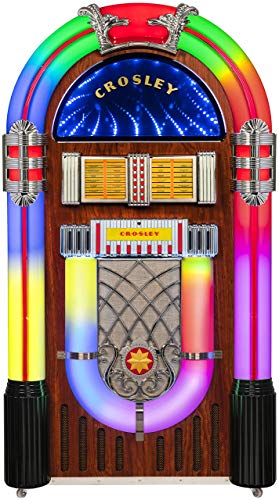
Crosley Full Size Jukebox
This player works well but where it really shines is how it looks. It was styled after the original Wurlitzer so it looks quite phenomenal! This is a large and heavy item so when you purchase it be sure and have multiple people there to help you move it and get it in position
Pros:
- Beautiful walnut finish
- Is on wheels to help move it easier
- Can connect external speakers if desired
- Programmable 20 track memory
- Front loading CD player
Cons:
- Bluetooth has a short range
- You have to pay for and order a bar stand if you want it to be higher. At this price point you would expect it to be included.
- Many people have reported issues with the CD player in this unit.
If you are interested in this model or a similar model you can find it on sale at Amazon.
If you are wanting to see what a more expensive machine has to offer you can find a high end model by clicking here.
Original Jukeboxes
Now to the best part, the original jukebox. Honestly no reproduction or mini desktop model could ever take the place of a vintage jukebox.
Of course these original models aren’t without their faults as they have those as well but there is nothing quite like owning an original. That is why many people prefer to buy a real pinball or arcade machine rather than a reproduction. The originals just somehow feel and sound better.
The Pros
1. Nostalgia
This is the number one reason that people buy jukeboxes in the first place but it is also the biggest pro about buying an original. If you purchase an original jukebox you can find the exact one that you remember from your local store or hangout and have it in your house!
Is there really anything better than that?
2. Price
You can often get a used original jukebox for cheaper than you can buy one of the high quality reproductions. This isn’t always true but if you keep your eyes on Craigslist, Facebook Marketplace, etc. and are patient you should be able to save a good chunk of money over the price of a top of the line reproduction.
3. Ease of use
Many of the new jukeboxes come with a bunch of features that can be complicated to understand and you simply might not want or need them all. If you purchase an original jukebox it will do one thing… play your favorite records!
The Cons
Of course this list wouldn’t be complete without listing the cons of buying an original model as well. Some of the biggest negatives to buying an original are:
1. Repairs
This is the number one issue with buying anything that is original, it will need some repairs. Since many jukeboxes are decades old there will be some repairs that will need to be done.
Even if you buy a model that has been well taken care of there will still be repairs that will need done over time just because of the age of the machine.
2. Lack of features
If you’ve read all of the above sections you will have seen that many of the new jukeboxes have a ton of features including bluetooth, radio, CD, and more. You won’t find any of those features on an original machine.
It will only play records and that is all.
This is something to seriously consider before you buy your new jukebox.
3. Large and Heavy
Of all of the above mentioned items the originals are going to be far heavier and larger than every single model we have mentioned. Things from years gone by were simply built more sturdy.
That extra size and weight might not be a bad thing for some people but if you have to take the jukebox to a second or third floor it certainly would be an issue.
Knowing that the jukebox will be quite large and heavy is an important thing to plan for as you certainly don’t want it to fall through the floor because you put it somewhere that couldn’t hold its weight!
Conclusion
That wraps up our post about the four different types of jukeboxes. There are of course many other models than just the few we listed here but it is important to know the types of jukeboxes before you decide on a specific one.
Take the time to read through the lists of pros and cons for each type and specific model and see which one appeals to you the most. Most people will find that one specific type will fit them the best and then they can do some more digging into that specific type of jukebox.
I hope this article has been helpful to you in your purchase decision. If you are interested in learning more about buying a jukebox you can check out the video below.