
*This post may contain affiliate links. As an Amazon Associate we earn from qualifying purchases.
Have you ever gone to play pool, but the shaft of your pool cue broke off? Maybe you looked around and saw a different pool cue and wanted to know if they were interchangeable. Well, in this article, we will go over everything you need to know about pool cue shafts interchangeable.
So are pool cue shafts interchangeable?
Although you may find that there are some pool cue shafts that are interchangeable, most pool cues are different sizes and the screws in the middle of them have different sized threads.
If you want to know more about pool cue shafts being interchangeable, you will want to keep reading. You can also check out this video to see exactly how pool cues are made.
If you are looking to get better at playing pool one of the best ways to do that is by upgrading your pool cue. One of my favorite cues is the Viking Valhalla. It is available in a variety of colors and won’t break the bank. You can find it by clicking here.
Should I own a pool cue?
If you play pool regularly or happen to own a table, then you should also own its cue stick. Since there are many cue stick brands available in the market, it isn’t straightforward to select the one that suits your playing style. Even if you are going with a regular pool cue, you should buy an extra cue so that if you have people over, they can still play pool as well and not have to use your special pool cue.
To make the interchangeability possible, the shafts have the beauty rings around the joining section. If you want to have pool cue shafts that are interchangeable, then you will want to buy the exact same pool cue shaft that has the same joining sections. This is the best place to buy pool cues that you can buy multiple of that way you can interchange them. The two pieces join together by thread pins of different sizes or by speed jointers. Joining these two pieces is not a complicated method.
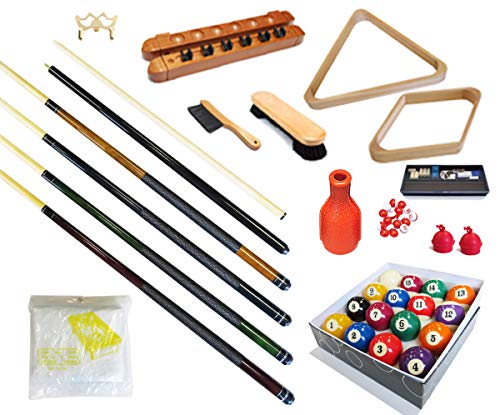
If you have a pool table then you need to get this accessory kit. It includes pool cues, extra pool balls, and all the gear you need to keep your pool table in tip-top shape.
If you are tired of your kids (or friends) ruining your good pool cue when they play then having these extra ones will keep that from happening (just be sure to hide your good one!).
What can I do if my pool cue is not the same connector as the other.
If your pool cues have different connectors, you can buy an adapter right here. This adapter will allow you to connect two different pool cues with different connectors together.
Once you own the adaptor you will simply place it in between the two pieces to make the connection possible.
Are there different types of pool cues?
There are many varieties of cue sticks available in the market. There are multiple versions of the low deflection ones, scorpions, and many more. Since there are so many different pool cues to choose from, buying one of them can be quite difficult. Some of these can be quite expensive and can put quite a dent in your bank account. This is why instead of going for separate cue sticks, you can buy the shaft of each one of them. This way, you can have the perks of different styles with the comfort of the same cue.
What makes up a pool cue?
A cue stick consists of three parts. These parts include the shaft, bottom handle, and the tip. All of these things play an essential role in the shot process. The handle is used to hold the stick, whereas the shaft is used for precise shot-making. The tip is also essential in a way that targets the areas of the ball. Therefore all of these parts add to the importance of a cue stick.
There are tons of cue brands available in the market. All of them have different sizes, circular diameter, circumference, etc. This is why the adjustability of one shaft with another should be done in a precise manner.
It can be seen easily by placing the rear shaft of the cue stick on the bottom handle. If the screw or the fork is adjustable and is rotating inside without any difficulty, then it means that these two parts of different cues are interchangeable.
Cue stick brands don’t only make just one standard cue for a pool game. Most places actually make many different sticks along with the standard one as well.
How to change part of a pool cue with another one.
The method to interchange the shaft of your stick with any other stick is straightforward. One thing you should know is that only the shaft of those sticks that are two pieces can be interchanged. The pool cues that are only one piece cannot be changed with any other pool cue as they are simply one piece.
To change or interchange the shaft, you need to separate the halves and connect the shaft with the bottom handle to the shaft you want to replace with.
The quality of a cue stick mostly depends upon the cue shaft. Other things, such as tip and handle, come later. Therefore replacing a cheap quality shaft with the excellent one will definitely improve your game and playing style.
Although attaching a high-quality shaft to the cheap quality bottom will have some adverse effects such as the bottom handle vibration adjustment factor. In addition, this effect will diminish over time as you get used to the stick.
Tips for pool cues
Experts give a few common tips regarding the interchangeability of the shaft of a cue stick. If you keep interchanging it after regular games, then there may be a possibility that one cue shaft might get stuck in some other cue stick’s handle. To avoid such situations, it is important to oil these moving parts regularly.
During the initial or starting phase of playing this game, it is often recommended to buy a cheaper cue stick. This is because it takes a good amount of time to practice and learn the basics. Some cheaper sticks for beginners can be purchased here.
Also, most people prefer to buy cheap cue sticks as an extra add-on to their table if others want to enjoy the game at the same time. However, they can be adjusted to make them play well. Their shaft can be removed and added to other cue sticks to make it workable if you prefer
You should always purchase cue sticks which the shaft of the stick is able to be changed with a different pool cue if you so choose. Buying a single stick that is not interchangeable does not make sense.
Conclusion
Now that you know most pool cue shafts are not interchangeable, you can make sure that you purchase ones that are interchangeable in case one breaks. This is the best way to make sure that you can repair or replace part of the stick if for some reason one of them breaks.
You also now know where the best place to buy pool cues is, as well as that you can buy an adapter to make sticks from different manufacturers work together.
Many people love their pool cues and will only use one specific one. Owning your own specific pool cue is very important when you are playing as your grip and cue that you use all affect whether you win or not. This is why most people prefer to own their own stick and if their pool cue shaft breaks they will be able to replace it and continue to play with the same pool cue handle. This is very handy especially if you are playing in a tournament.