
*This post may contain affiliate links. As an Amazon Associate we earn from qualifying purchases.
Have you ever gone to purchase a pool cue, and you wanted to know if it came with a tip? Maybe you know that the tips can be replaced, and since they can dry out maybe they don’t come with tips? Well, in this article we will answer all of your questions about pool cues and if they come with tips or not.
So do pool cues come with tips?
Although most people order special pool cue tips for their pool cues, if you order a new pool cue it will come with a tip on it already. The tip may not be the one you want, or the best quality, but it is normally sufficient for most novice pool players.
If you want to know more about pool cues and them coming with tips you will want to keep reading this article. You can also keep reading to know what the different types of tips are and what they are used for.
If you are looking to get better at playing pool one of the best ways to do that is by upgrading your pool cue. One of my favorite cues is the Viking Valhalla. It is available in a variety of colors and won’t break the bank. You can find it by clicking here.
Is pool popular?
There are several types of games here available in the world. All of them are very popular. Among them, the pool is one of the most favorite ones. It is played by people from across the globe. For its unique and splendid features, it is getting popular with the flow of time. To play a pool game, it is very important to have the right shape of the pool cues. Even, the performance of a pool cue depends on the shaft. It also lies in the first six inches of the pool cue. And the very last part of a pool cue is called the tip. It is the place where the cue ball gets the whole energy. It is a vital part to play a pool game properly.
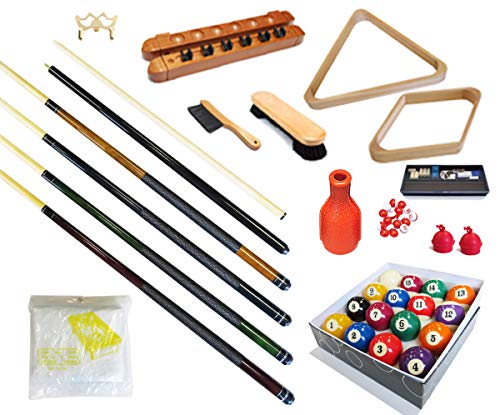
If you have a pool table then you need to get this accessory kit. It includes pool cues, extra pool balls, and all the gear you need to keep your pool table in tip-top shape.
If you are tired of your kids (or friends) ruining your good pool cue when they play then having these extra ones will keep that from happening (just be sure to hide your good one!).
Are there different types of tips?
To play a pool game, it is an essential part to have the pool cue. The very last part of a pool cue is named tip. It is not possible to play a pool game properly without having a tip on the pool cue. It transfers energy on the cue ball to produce enough accuracy, speed, and spin. It is also very important to choose the right tip. Because the right tip can help you to perform better in a pool game. There are many tips brands available in the current market. Among them, Zan, Elk master, Kamui black, Da Vinci, Blackheart and so on.
Choosing the right tip
It is much needed to choose the right tip for the pool cue to play a pool game. One needs to keep some important features in mind to choose the right tip. The main characteristics that should be kept in mind are density and hardness. A pool cue tip may be varied in hardness from super soft to hard depending on the cue ball and playing style. There are four types of tips available. They are different in density and size. You can choose any one of them depends on your need-
- Soft tip
Soft tip compresses at the time of hitting on the cue ball. It will absorb more impact at that time. It stays a little extra more time on the cue ball during the hitting time. As a result, the cue ball will spin more. Using soft tips, it is possible to get better control over the ball. For this, the result will be more accurate. But the soft tips also tend to get misshaped earlier and more maintenance is needed. You may need to replace it more frequently. If you can maintain properly and want to have more spin, then you can choose the softer tips.
- Hard tips
Hard tips do not so much compress at the time of hitting on the cue ball. It does not absorb much impact during the game. That’s why it stays less time compared to the softer tips. As a result, it is not possible to get much spin during the game. Even, you can play more consistently for a long time. It does not need to have much maintenance. If you don’t need much spin, then you can choose hard tips. It will be beneficial for you if you lack the knowledge of maintenance.
- Medium tips
Medium tip lies between softer and hard tips. It is preferred by most pool players. It is softer than the hard one but less than a soft one. It compresses on average shape during hitting the cue ball. That’s why it absorbs adequate impact at that time. You can spin as much as you need using the medium tip. Even, they will not be misshaped earlier and extra maintenance is not needed also. It will not wear out as well. That’s why you don’t need to be anxious also. If you are an advanced level player, medium tips will be the best option for you.
- Phenolic Tips
Phenolic Tips is one type of hard tips. They are also known as carbon fiber. They are useful to play the break shots. As in the time of playing break shots, you need to hit on the center of the cue ball, phenolic tips will put a solid and smooth hit on the cue ball without miss-cueing. As it is as hard as the cue ball, it is the best option for playing break shots. Currently, these tips are very familiar because of their power transferring quality. The best facility is that you don’t need to have maintenance skills to play with that. But the only problem is that some pool halls never allowed this tip.
Significance of pool cue tips
It is very essential to have the tips on the pool cue. It is the medium that makes contact with the cue ball properly. You can play a pool game without pool cue tips. But it will not be a professional game. You will never be able to play smoothly. Sometimes, it may seem mishit over the cue ball. Sometimes your cue ball will break down. The front part of your pool stick may also be broken. Besides, it is very necessary to have the right spin and angle during hitting on the cue ball. Without a tip, it is not possible to produce and have control over the cue ball. That’s why the whole intention of a pool game will go in vain. As a result, it is a must-have to play a pool game. To play an accurate and consistent game, the pool cue tip is a vital part of a pool game. That’s why the importance and significance of a pool cue tip are more.
Conclusion
Pool is one of the most amazing fun games in the world. Even though it is extremely popular, most people don’t realize how important it is to have pool cue tips that are not dried out while playing the game. A pool cue comes with different types of tips. Now that you know what the different tips are and what each one of them is for, you can accurately decide which pool cue tip you should have on your pool cue and when you are going to install it.
You will want to make sure you do not install a soft tip too early before you plan on using it. If you do, the tip may actually dry out before you get to use your pool cue and then that can easily cost you the game. If you are playing professionally, this is something that you will definitely want to know and keep track of, as one mistake about your pool cue tip could cost you an entire championship.
No matter what pool cue tip you have, if you buy a new pool cue, it will come with a tip already on it. Although it may not be the best quality tip or the most expensive, it will meet the needs of most novice pool players.