
*This post may contain affiliate links. As an Amazon Associate we earn from qualifying purchases.
Do you own an Atari and wondered if they were region locked? Maybe you prefer to play international games and you are considering buying an Atari Jaguar.
So is the Atari Jaguar region free?
Although there is some confusion about whether the Atari Jaguar is region free or not, you will be happy to know that the Atari Jaguar is region free.
If you want to know more about the Atari Jaguar and the history of it, and what being region free really means, you will want to keep reading. You can also watch this short video to learn all about the console and games for it.
If you are an old-school Atari lover then you have to get a classic Atari T-Shirt to show it! To see the most popular Atari T-Shirt retro designs that will stay classics for years just click here.
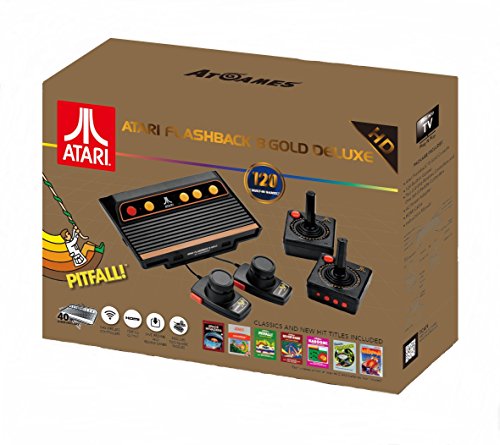
If you love all things Atari then you have to check out this awesome Atari Flashback console.
The Atari Flashback 8 comes with two wireless controllers (YES, WIRELESS!) two paddle controllers, and 120 authentic Atari games.
How did the region code chip work?
This is basically what happens during the boot process of the console. Once the console’s region interface opens up, the Jaguar determines which screen size and frequency to use for the games. Once this is determined, the application is automatic. Therefore, there is no need to do anything extra except waiting for the booting process to conclude before coming to the prompt where one chooses what game is of interest.
This meant that if you were in the United States it would automatically recognize this, and make all the necessary adjustments to be able to play the United States games as well as have the appropriate settings for the television that it was being played on. This was incredibly advanced for when the console was released. Before this console no one had ever created anything this advanced or able to do something like this.
With this information in place, everyone is able to enjoy the game without the concern of restriction of the region. This makes the console to be in high demand throughout the world as This console was one of a kind.
Can I still buy an Atari Jaguar today?
If you are interested in buying an Atari Jaguar today, they are still available. Unfortunately they are not widely available, and they will probably not be in the box or brand new. If you are able to find one still in the box or brand new, it would be extremely rare, and easily worth money.
If you are looking to buy one, you should look at the following places:
- Online
- Thrift Stores
- Garage sales
- Gaming conventions
- Parents basements
Although you are not guaranteed to find one of these consoles at any of these locations, these are the places we were able to find them, as well as other people looking. If you are looking to buy one immediately and you do not want to search, there are some available here.
Why is being region free so important?
A question like this brings a very important concern that is put across the globe. Many electronic gadgets that are being manufactured come with specifications. These specifications are sometimes factoring in particular operation locations.
Since the world now exists as a globally connected world, there is a need to standardize every gadget. Once the gadget is manufactured for the market, the wide consideration should be that at any one time, it will find itself out of the region it was manufactured in. This could be either through purchase or traveling of the one who possesses such gadgets. This calls for manufacturing standards to make sure that the console will work in every region.
The other important concern is the after the sale, some consultation will be needed. This could be made accessible by having dealers awarded the licenses to be able to help consumers on every corner of the globe. This brings us to the reality of job market expansion through this initiative.
Technicians will also be needed to look at the consoles and repair them if they ever stop working or have a broken piece. Sales agents will be needed as well for the accessories to find their way to the consumers. In this way, the region factor in electronic gadgets will come with the right impact on the market.
Another concern that can be of a major problem, is that taking care of the gadgets once they are broken. Instead of throwing them away, there should be a process of collecting the consoles either for refurbishment or returning them to the factory for reusing the spare parts.
The manufacturing of these gadgets with the locking of the regions will soon become a very backward trend that all factories should move away from. Unfortunately as of today, most consoles are still region locked even though the world is more connected today than ever before. The reason they are still not all region free is the simple fact that people take advantage of playing other countries’ games and buying the same games from different countries for cheaper, and then playing them here in the United States.
The Atari jaguar history
The Atari Jaguar is a home video game console that is 64-bit. It was developed by Atari Corporation with the designing work landing on the hands of Flare Technology. It was released in 1993 right inside North America. This was Atari’s Sixth console that they had introduced into the gaming market, as far as home console systems were concerned.
There are several games released for the Jaguar. Unfortunately not all of the games were released for the United States, which is why the console being region free is such a big deal.
The initial designing and the first production of the Atari jaguar took place in North America. It was the work of only two people and this came with an obvious implication. The gadget was going to be very expensive since there was a constraint in production. Another concern would be the issue of the region specification. The pioneers of the gadget had the obvious concern of the gadget not being able to be thrown in the market before undergoing a thorough check to ascertain it works properly. Therefore, the issue of region specifications was very important at this particular time to handle.
Upon the fall and disappearance in the market of the Atari Corporation, new forces in the market emerged and they came with a multinational approach. This approach brought in a lot of expertise both locally and internationally. Eventually, there was no major concern as far as further development of the Atari jaguar was concerned. One must note that the closing of one door opened eleven more, the work of developing the console didn’t take long before the results expected came up. There was an international presence which took care of the concern of not only traveling abroad with the gadget but also buying and being able to use the gadget worldwide. It would be easy to find repair assistants who would bring back your gadget to life in case it was malfunctioning.
Conclusion
Now that you know the Atari Jaguar is region free, you can enjoy it knowing that you can play it in any country as well as play games from any country. This console was super advanced when it was released, and even today remains a favorite because of the console design and the games that were made available for the console.