
*This post may contain affiliate links. As an Amazon Associate we earn from qualifying purchases.
Atari is a brand name owned by several entities since its inception in 1972, currently by Atari Interactive, a subsidiary of the French publisher Atari, SA. The original Atari, Inc., was founded in Sunnyvale, California in 1972.The company’s products, such as Pong and the Atari 2600, helped define the electronic entertainment industry from the 1970s to the mid-1980s.
In 1984, as a result of the video game crash of 1983, the original Atari Inc. was split, and the arcade division was turned into Atari Games Inc. Atari Games received the rights to use the logo and brand name with appended text “Games” on arcade games, as well as rights to the original 1972–1984 arcade hardware properties.
In 1998, Hasbro Interactive acquired all Atari Corporation related properties from JTS, creating a new subsidiary, Atari Interactive.
So what were Atari games programmed in?
Although there are many different languages that programming can be written in, most Atari languages were written in C.
If you would like to know more about what Atari games are programmed in, you will want to keep reading this article as we will go more into depth about why they were written in this language. You can also check out this video to learn about the Atari basic programming.
If you are an old-school Atari lover then you have to get a classic Atari T-Shirt to show it! To see the most popular Atari T-Shirt retro designs that will stay classics for years just click here.
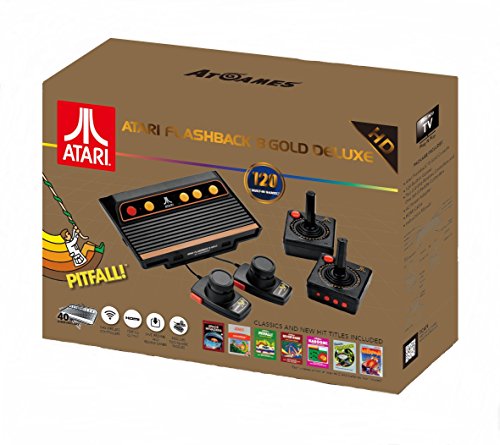
If you love all things Atari then you have to check out this awesome Atari Flashback console.
The Atari Flashback 8 comes with two wireless controllers (YES, WIRELESS!) two paddle controllers, and 120 authentic Atari games.
Computer Programming
If you are a computer geek, you probably know a lot about programming. Games are usually written in a particular programming language but there are different languages in existence.
With so many programming languages in existence, each game has its unique code based on the language it uses.
The code of each game is responsible for everything the game has to offer. Starting from character movement to moving between levels. All of it is written in the program and embedded in the cartridge.
This is why different cartridges are for different games as each different cartridge will have a different program written on it.
Whenever you want to play a different game, you will need to change the cartridge. The cartridges have different sizes and this is why it is possible to have more than one game on a cartridge. This is achieved by inserting more than one code on a single cartridge, as long as the cartridge can contain both codes.
This is the reason why we had cartridges that contained as much as 16 in 1 games on it. It just means that the cartridge is large enough to accommodate up to 16 different codes.
Atari Programming
Atari games were programmed between the 1970s and 1990’s and programming wasn’t as advanced as it is now. The codes for the games on this console are regarded as basic but when you don’t know much about coding, it may seem difficult.
As a programmer, one of the first codes you can write are those for Atari games. This is because they are simple enough to write, but complex enough to give you confidence to attempt more programs. In some cases, you may want to write a code for a game that has similarities to one of the games that was on Atari.
This will require you to take a look at the original code, before creating a variation of it to match your requirements.
You will need knowledge on the language used to create the Atari game. Luckily, most Atari languages were programmed in C. You may find similarities with other languages, but C is the original language.
There are those who believe that Atari games were programmed in 6502/6507 assembly language and they are not wrong. However, it is not entirely correct as those were used as an extension in C to program the games.
Programming An Atari Game
If you are already a programmer, you probably already know what to do and don’t need any help programming an Atari game. If you are new to programming, then you need a little help and we will take a look at the process.
For those that use a different programming language, the process may be the same, with just a few variations. Here are the things you need for programming an Atari game.
Text editor of your choice
The text editor refers to the program you are using to write your code. Nowadays, we have programming like python, java and matlab, all of which require different languages.
The text editor you will use will be determined by the language of your choice. Here in the text editor, you will develop the source code for the game. The source code you develop here is the base for the game as it will contain all the necessary information.
Your language of choice will determine the code you are writing, as each language is different from the rest.
DASM assembler and ‘2600 support files
When you are done writing the code for the game, it needs to be converted to a language that can be recognized by the game, or the emulator that will be used in testing it. The language that a cartridge can understand is binary.
This is where an assembler comes into play. An assembler can translate a code from the language it is written in, to binary.
The support files are what will help the assembler convert the source code to binary, so they are very important. The support files vary depending on the language the code was written in.
Emulator (Z26 or Stella)
Once the program is complete and has been converted into binary, it can be written into the cartridge. Before you write it into the cartridge, you need to test the game you have written on a device that can serve as the game console.
This is where an emulator comes in. An emulator will give you the necessary requirement and read the language of the console. You can test your game to see if there are any flaws before you are finished.
At this point, the game is ready to be played. Many times programmers like for their game to be played all the way through if possible in order to see if there are any bugs that need to be addressed.
Stella programmer guide
For veteran programmers, this may not be necessary. For those that are new to programming or are still developing their skill, you will need this. To use the Stella emulator in the right way, you will need the programming guide.
With this guide, you will be able to make use of the emulator and obtain the best result possible.
The success you will get from the game will be determined by your progress with the emulator. This is because the emulator will display the result of the work you have done with your code.
With the right usage of the emulator, the result will be accurate based on your code. If the emulator is not used right, you will not get the proper result.
Conclusion
Once the code is complete, you can write it to the cartridge and play it on your Atari console. All the work involved in the writing of the code will be in C language, but may involve variations with other programming languages.
Now that you know most games are usually written in a particular programming language but there are different languages in existence, you can understand why this question is asked. Now that you know most Atari games were written in the C language, you can be sure to let all of your friends know, or code your own Atari game.