
*This post may contain affiliate links. As an Amazon Associate we earn from qualifying purchases.
Have you ever wondered if it was actually possible to beat Tetris? Maybe you are playing it on your Gameboy and you want to know if there are different levels or if you run out of blocks. Well, in this article we will go over everything you need to know about Tetris and if you can beat it on the Gameboy.
So can you beat Tetris on the Gameboy?
The Tetris game on the Gameboy is actually never ending. However, there have been some people that have gotten the highest score the Tetris game on the Gameboy goes up to which is 999,999.
Even with their game having the highest score possible, they still did not get anything special, and the game ended the same as someone who only scored 1200 points… by them being unable to stack anymore blocks.
If you want to know more about Tetris, you will want to keep reading. You can also check out this video of how someone reached the high score on the gameboy of 999,999 points and cleared a total of 641 lines.
Are you a huge Nintendo fan? Then you have to check out the Mario and Nintendo gear that you can get. Whether you want a Mario wallet, a Nintendo sweatshirt, or a classic NES hat there are plenty of choices to choose from. You can find them all by clicking here.
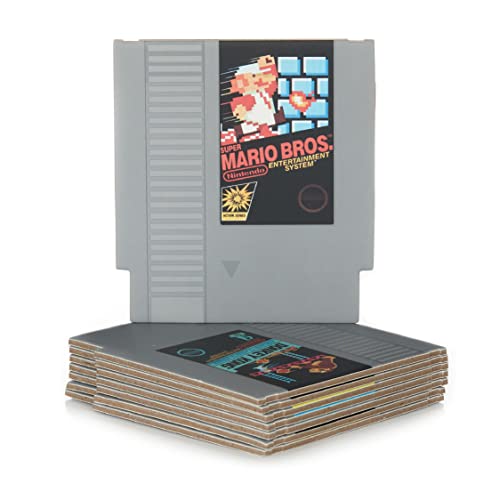
Do you love Nintendo? Then you have to check out this amazon NES cartridge drink coaster set!
This set includes 8 double sides drink coasters that look just like the classic NES cartridges.
This set is a perfect gift for the gamer in your life!
Was Tetris Only On The Gameboy?
Tetris is a game that many people loved to play, and even today is still being played all over the world! The game was bundled in the North America and European releases of the Gameboy itself.
Tetris was originally created by Alexey Pajitnov. He was a Russian video game designer and computer engineer. Nintnendo purchased the rights to the game, but in 1996 they went back to Pajitnov. From that point on, Tetris was able to be licensed and put on many different gaming devices as well as even some arcade games.
Tetris is actually very trendy, especially the colorized remake of the game that was made for the Gameboy Color called Tetris DX. Other Nintendo consoles such as 3DS have a version of the game that was released in 2011. The game was delisted from Nintendo eShop after December 2014, but gamers across the world have been playing to beat Gameboy Tetris, since it was released on the device.
The Gameboy version plays identically to the versions on other platforms. It uses shapes that each fall down the playing field, which is 10 blocks wide by 18 blocks high on the Gameboy. The goal of the game is to manipulate these Tetrads by moving each one sideways and then rotating it by 90 degrees units to create a horizontal line of blocks without gaps.
Creating one or more lines across will make them disappear. When they disappear, the blocks above move down to the empty lines. This is continued until you do not clear enough lines and the blocks reach the top of the playing field.
The more lines you get rid of, the faster the blocks begin to fall.
Why Can You Never Beat A Tetris Game?
As in most standard versions of Tetris, blocks do not automatically fall into open gaps when lines are cleared.
Using pure mathematics, it has been proven that Tetris can never be beaten. Over the years, many players have tried to beat the game, but none have come out victorious.
The game involves seven tetrominoes that can fit together in different ways. In most cases, the shape of the rectangles they create is eight blocks wide. The Tetris board is ten blocks wide, and to complete the game, you have to fill in the extra space.
The game also goes into the snake sequence. The snake sequence is where you get alternating S and Z pieces. When you get enough of these in a row, it creates gaps that cannot be filled. At this stage is when the Gameboy version of Tetris gets fun and intriguing.
The game basically makes it impossible to win by giving you pieces that you cannot make a full row with no matter what you do. This is one of the biggest reasons someone will never beat Tetris. The game is simply rigged against you.
How To Get A High Score On Tetris?
Everyone who loves Gameboy games has played Tetris, and has enjoyed it while hating it at the same time. The game in the last three decades has sold over a million copies around the world, which has created a large number of enraged players on their commutes to work.
You can access the game on virtually every console known to man. Over the years, the game has seen a slew of imitations, but none have ever matched the original Tetris game.
Gameboy lovers have been playing Tetris for over 30 years. You would think that by now they would have figured out a way to beat the game, but as of yet they have not.
The main reason for this is that the game is actually unbeatable! This is why Tetris players should learn to enjoy the game and be happy getting high scores.
Does Tetris Have An End?
In a real gaming world, Tetris doesn’t end with some giant boss battle. Instead, you play against yourself by quickly making sure the blocks don’t reach the top as the speed increases.
When you start the game it is pretty straightforward, but as soon as the speed increases, it doesn’t take long before it becomes nearly impossible to keep up with the falling blocks.
This is going to end poorly until you learn how to keep up with speed. Don’t give up yet though, as it takes time to learn and master Tetris.
The thrilling part of Tetris is the game’s call for total focus. Your eyes will have to adjust to the speed of the blocks falling as the game gets harder. You will be playing and you will narrowly dodge mistakes that would end your game in an instant.
A simple zig when you are supposed to zag, and the game comes tumbling down, and you have to start all over again. This is what makes the game so addictive.
With each try, you work on earning higher scores than you just got. After some time, you will technically beat your high score, but still lose the game.
At least you feel nice each time you achieve a new high score.
When the game ends, you won’t get the usual Gameboy game over message. Instead, Tetris rewards you with one of the most confusing endings of all the time. There is a dance, and then you will see a space shuttle take off.
This space shuttle looks like the kind that NASA used to send to the moon. It has double rocket boosters and everything. No matter what your score is for the game, this is exactly how the game ends every time.
Almost as if you beat the game, but you know you didn’t.
Conclusion
Now that you know that Tetris is impossible to beat, you can play on your Gameboy, or any other device that you want, and you know it is not about beating the game, but beating yourself and your friends’ high score.
Tetris is fun if you keep this in mind and do not get frustrated that you cannot beat the game. The popularity of this game shows you just how many people have tried and failed to beat this game in its lifetime.
Today, Tetris is still popular, and is played on many computers and phones all over the world!