
*This post may contain affiliate links. As an Amazon Associate we earn from qualifying purchases.
The Sega Corporation is a Japanese multinational video game developer and publisher headquartered in Shinagawa, Tokyo. Its international branches, Sega of America and Sega Europe, are respectively headquartered in Irvine, California, and London. Sega’s arcade division existed as Sega Interactive Co., Ltd. from 2015 to 2020 before it merged with Sega Games to create Sega Corporation with Sega Games as the surviving entity.
When did Nintendo Acquire Sega
There was a false news story published in the New York Times in December of 2000 stating that Sega and Nintendo were in negotiation talks for their companies. Both companies denied it. Nintendo actually does not own Sega.
If you would like to know more about this story, keep reading!
Are you a huge Nintendo fan? Then you have to check out the Mario and Nintendo gear that you can get. Whether you want a Mario wallet, a Nintendo sweatshirt, or a classic NES hat there are plenty of choices to choose from. You can find them all by clicking here.
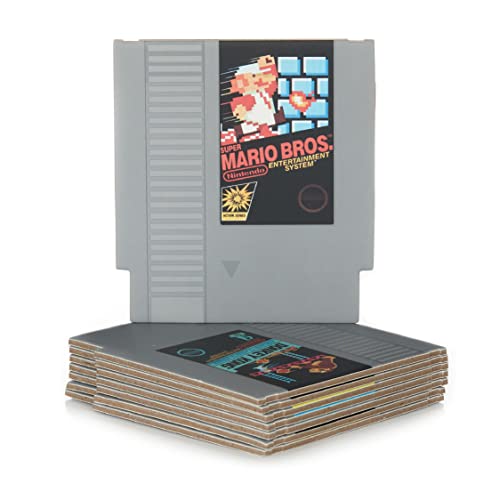
Do you love Nintendo? Then you have to check out this amazon NES cartridge drink coaster set!
This set includes 8 double sides drink coasters that look just like the classic NES cartridges.
This set is a perfect gift for the gamer in your life!
Unverified Story
The story, published by the New York Times in December of 2000, stated that Nintendo, the Japanese computer game organization that promoted arcade-style games at home, was in conversations to purchase Sega, the ambushed computer game creator that reformed the business in the mid-1990s with its whimsical characters and eye-popping virtual universes.
As indicated by administrators near the negotiations, the two organizations had conversations that prompted Nintendo to take over Sega for about $2 billion. The discussions went on for a considerable length of time, the officials stated, and the agreement could be at the breakdown.
A Sega representative, Munehiro Umemura, firmly denied that the deal was in progress. He said this proposal was ”totally absurd” and utilized a Japanese word that can mean unwarranted gossip or falsehood. A representative for Nintendo laughed when he was questioned whether both the organizations were in negotiations.
The story turned out to be false, even though the New York Times never admitted it or printed a retraction. Stocks fell because of the story among other fallout. Sega has never really recovered its footing or become one of the top gaming companies.
Sega Dreamcast
Notwithstanding, Dreamcast’s cutting edge innovation and record-setting presentation gave them a slight win in September 1999. Dreamcast sold 500,000 units in that month alone, but Sony’s PlayStation 2 broke the record that year and demolished Dreamcast’s lead.
Sega History
Sega has been battling its competition since Sony entered the computer game market in the United States in 1995. Where the game-players liked its machines, Sega did not have the advertising muscle to draw clients towards them which helped Sony’s PlayStation to become one of the most popular games worldwide.
In spite of the fact that Sega was the first to present a 128-piece microchip, which permitted refined graphics, the Dreamcast never really got up momentum. Starting deals were damaged when the NEC Company experienced difficulty delivering enough of the intricate chips that created the ongoing visual pictures that Sega guaranteed for the Dreamcast. When more chips were finally accessible, Sony already promoted PlayStation 2 and Nintendo was dropping proposals about another machine known as GameCube.
In any case, to seek the support of customers from PlayStation 2, which was presented in the US in October, Sega decreased the cost of Dreamcast by 25 percent that year. Dreamcast sold for $149; whereas the retail cost of PlayStation 2 was $299.
Sega Programming
Sega holds 13th position in programming deals in North America; after both Nintendo and Sony and programming pros like Electronic Arts. Sega created programming for Nintendo’s Game Kid unit, and the investigators in Japan regard their product advancement arm to be well-built.
The programming developers opposed the complexity of creating games for the PlayStation 2, which offered Sega and others a chance to cut into the colossal serious edge Sony worked hard for with the first PlayStation. In spite of its well-chronicled hardships, Sega had a few good qualities. Its arcade business flourished and computer games moved online which allured its players.
Sega additionally started, as a perk for its Sega.net clients, offered the customers a free Dreamcast console on the condition that they had to utilize their internet access for about eighteen months. Due to this, Sega once more pushed itself forward from its rivals. Segas major concern seems to be that it can never appear to profit by its leader status. It is always coming up short on the money related side of Sony and the reasonability of Nintendo.
Eventually, Nintendo and Sega proceeded to progress with an incredible relationship that is still maintained until the present time. Sega launched numerous extraordinary games on Nintendo platforms in the years following the downfall of the Dreamcast. Nonetheless, what the two organizations endured on account of a minor blunder in interpretation demonstrates that even the most highly regarded news outlets are not faultless.
Who Owns Sega
The Sega company is owned by Sega Sammy Holdings. Sega’s association with Nintendo goes back to 1976, when Sega introduced Wild Gunman and Shooting Trainer to North American players. The two were also competitors in the home game console business until Sega left the business in 2001.
What Came First, Sega Or Nintendo
Nintendo started out as a toy company (initially with Hanafuda cards) all the way back in 1889, easily making it one of the oldest, if not THE oldest game companies in the world. Sega, by comparison, was founded in 1960, a full 71 years later. Nintendo came first, if we are purely talking as a company.
Will Sega Ever Make Another Console
2020 is the year of the next-generation console. The Xbox Series X and PlayStation 5 are slated to launch this holiday season. But there may be new hardware entering the battle, coming from Sega of all companies.
Why Did Sega Consoles Fail
Sega failed because they tried too hard to compete with other companies than to put their focus on growing their own. When the SNES came out, they made the Genesis. Then they upgraded it with the 32x, a risky decision. Then they did that again and made the CDx. Failing every time because they were more worried about their competition than what they could create for their customer.
Conclusion
Nintendo did not acquire Sega. The story was false and hurt both companies. Sega has not ever been a contender in the top gaming systems because they are more focused on their competitors than their product development.