
*This post may contain affiliate links. As an Amazon Associate we earn from qualifying purchases.
With so many different Sega consoles out there, how do you decide which one is the best? In this article, we will go over everything you need to know to learn what Sega console is the best one!
So which Sega Console is the best?
Sega has made many great consoles over the years but based on sales alone the Genesis was by far the best Sega console. The Sega Genesis sold almost 30 million consoles when it was released.
In this article, we will be breaking down each different Sega console and explaining the differences between them all. If you would like to learn more about Sega consoles and which one we think is the best and why, you will want to keep reading. You can also watch the video below if you are like me, and you do not like to read.
Are you a huge Sega fan? Then you have to check out the amazing Sonic and Sega gear that you can get. Whether you want a Sonic wallet, a Sega sweatshirt, or a classic hat there are plenty of choices to choose from. You can find them all by clicking here.
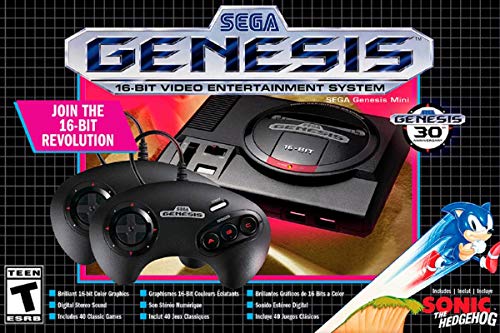
If you love Sega then you will want to check out this Sega Genesis Mini console. It comes with two controllers and even comes preloaded with 42 Games!
Enjoy these classic Sega Genesis games without having to purchase a single game cartridge!
What are the most popular Sega Consoles?
When the Dreamcast was released, it was an impressive system. It used visual memory units for memory cards, which slid in and out of the controller and allowed you to play mini-games.
The Dreamcast was the first console to ship with a modem, and it was the first ever console that had online gaming. Sadly, the Internet was not widely available and only the upper class could afford it. Because of this, the internet part of the Dreamcast never took off. If you had a Dreamcast and internet though in 2000 or 2001, you could enjoy games like Phantasy Star Online, Quake 3, and others.
Not only was the dreamcast far above its time as far as having online gaming, its design also played a part in everyone loving the console. The little triangle that would light up on the console made it feel like it was high tech and something out of a magazine that was super expensive. This tiny little light brought joy to everyone who turned it on.
Another part of the dreamcast that made it popular were the controllers. They were extremely comfortable in your hands, and could be held for hours without realizing it. The fact that they had a little screen on them to play mini games also made the controllers something that no one had ever seen before.
The games for the Dreamcast were exclusive, and were ahead of their time as well. There are many games that people love to play on the Dreamcast, and the best part was that they were not available on any other system! Even though not every Dreamcast game was the next best seller, every single Dreamcast game was unique.
The dreamcast was so far ahead of its time, and so advanced, that it wasn’t until almost 15 years after it was released that other consoles began to publish games online and allow online access to games through their gaming system. This was one major thing that set the Dreamcast apart from every other gaming system of its time. Sadly, the Dreamcast was so far ahead of its time, that no one else was in its league and the Dreamcast became a thing of the past before online gaming became prevalent.
Although the Dreamcast was a great success when it was released, its success was not long lived. The Dreamcast put more emphasis on its games, than it did on the next big console. This is how we ended up with such iconic games as Sonic the Hedgehog which is still known by everyone today, but we do not have a game system to play it on. Sonic was by far the biggest and best game that Sega has ever produced.
Even though their game systems did not have all the work that the iconic games did, their systems, still had quite a bit of power and technology packed into it. Sega even went as far as saying that the Dreamcast was the most powerful console available at that time.
Overall, the Dreamcast was a great gaming system with many different games that were able to be played only by the Dreamcast. This as well as all the features of the system made everyone want to own a Dreamcast when they first released.
- The Sega Saturn
The Sega Saturn had limitations like mismanagement. The expense of the system, the development was a nightmare, and the launch just went all wrong. Despite these limitations, The Sega Saturn was still the best console when it came to certain things.
The Sega Saturn was the best console ever for multiplayer games. These multiplayer games were something that had never been done before. These games not only allowed two people to play together, but it allowed up to 10 players to simultaneously play on one single Sega Saturn. This had never been done before, and even though it was new technology, it was something that every single gamer all over the world loved!
The Saturn had many different games that everyone loved to play, but it was really the microchips in the system that made people love playing the games on it. When the Saturn released, 2d games were becoming boring and 3d games were all the rage. Sega knew this, and made the Saturn able to handle many 3d games. This drew in a lot of people that would have normally just kept their previous gaming system.
Although not everyone knows this, Sega actually began to publish a magazine called the Saturn magazine. Most of the time the magazine would be well written, funny, and have hidden features in the magazine that you would want to look for.
Even though the software in the Sega Saturn was new for the time, Sega made the Saturn with quality parts. Because it was made so well, not many people had any issues with the console.
The Sega Saturn has been around for many years, and even though people do not play the Saturn for fun anymore, there are still many Saturn consoles available in working condition.
- The Sega Genesis
The Sega Genesis was the only console that had a useful lifespan and good games simultaneously. The Genesis had a massive library of games, as well as hardware, and software that worked for the system. The negative side of the Genesis is that there’s no rewind feature. The controller cord is also too short, and Street Fighter 2 is a nightmare to play because the controller only has three buttons. This caused many people to dislike the Genesis and not buy it when it first released.
- The Sega Game Gear
The Sega Gear was the best portable game console at that time. Even though it took 6 AA batteries, it had a superior display, an excellent game library, and a TV antenna adapter that would let you watch local channels on your device! Although that does not sound like it is something special, in 1992 when the Game Gear was released, there were still many people that did not have any portable devices.
This was the major reason that the Game gear was such a big story when it was released. Even though the Game Gear had some great games and was portable, the Sega Dreamcast was still more popular than the portable Game Gear.
Conclusion
Now that we have gone through each of the consoles and showed you all the information about the top Sega consoles, you can easily see that there are definitely some consoles that are better than others. There are many people that believe the Dreamcast is the best Sega console, but there are also people that prefer a different one. Based upon sales and specs, more people will agree that the Dreamcast is the best Sega console that was ever made!