
*This post may contain affiliate links. As an Amazon Associate we earn from qualifying purchases.
Have you ever been playing a game of pool and had a different set of rules for the game than someone else? This is actually very common, as different types of pool have different sets of rules. If you want to know more about pool and the different types of rules, you will want to keep reading.
So what are the rules for different types of pool?
Depending upon what type of pool you are playing will depend upon what rules you will play by. Every set of rules is different based upon the type of pool you are playing.
If you want to know more about the different rules and the different types of pool, you will want to keep reading this article. You can also check out this video that will go over the difference between pool and billiards.
If you are looking to get better at playing pool one of the best ways to do that is by upgrading your pool cue. One of my favorite cues is the Viking Valhalla. It is available in a variety of colors and won’t break the bank. You can find it by clicking here.
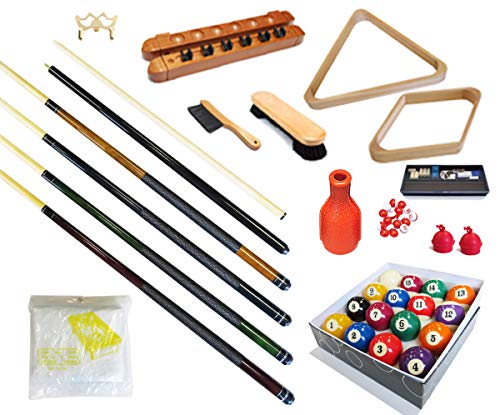
If you have a pool table then you need to get this accessory kit. It includes pool cues, extra pool balls, and all the gear you need to keep your pool table in tip-top shape.
If you are tired of your kids (or friends) ruining your good pool cue when they play then having these extra ones will keep that from happening (just be sure to hide your good one!).
What is Carom?
Carom is a game popularized by Wayman Crow McCreery of St. Louis Missouri. It became popular in the 1870s. In January 1878 the first ever three-cushion billiard tournament was held. The table was unlike anything that was around at the time. It didn’t have any pockets, or openings to hit the balls into. Instead the game is played where the players score points by hitting their ball into the opponents ball, and then bouncing off of three rails and then hitting the third ball on the table. Here is also a short video showing you how to play the game.
What are the Rules in Carom?
Any shot other than the break shot, the cue balls may contact other balls first. In order to score a point, the player’s cue ball must hit one of the other balls, bounce three times off of any rail, and then hit the third ball on the table. If this happens, the player will earn a point, and will continue with his turn. The player will continue to do the same thing every single time until they do not accomplish all of the tasks properly. This will end their turn, and the opponent will try to do the same thing. The players will do this until one person reaches the certain amount of points that was determined before the game began.
Are there fouls in Carom?
Although most people think the game sounds easy, it is actually one of the hardest billiard games that there is. On top of the specific order you have to hit the balls and rails in, there are also fouls, that can cost you a turn. If you lose a turn in this game, it can easily cost you the game. One of the most common fouls is that a player will accidentally bump a ball on the table when setting up their shot. This will cause them to lose their next turn.
Another way players can lose a turn in Carom is by accidentally striking the cue ball twice, or with anything other than the cue tip. You can also lose a turn when the cue tip stays in contact with the cue ball for longer than would occur on a normal shot. This type of shot is called a push shot. It is considered a foul resulting in loss of turn of the player.
Another thing that you are not allowed to do is to make a shot while one ball is still in motion. You can also lose a turn if you shoot the opponents cue ball as your own. The main difference when lining up a shot in Caron and 8-ball, is that you are not allowed to fully lean on the railing of the table. You must at least keep one foot on the ground while shooting. Most penalties for an unintentional foul is a loss of turn. If a carom is made on a foul then there will be no score.
What is the most popular billiard game?
The most popular billiard game is the game of 8-ball. It is most commonly referred to as pool. The game is played with a cue ball and fifteen billiard balls that have number markings from 1 to 15. One player must pocket balls first from 1 to 7 for solid colors while the other player is from 9 to 15. Once all their designated balls are pocketed then then they may attempt to pocket the ball with number eight marking to win the game.
What are the rules of 8-ball?
Although there are many ways to play pool, most people play where you must call the shot you are attempting to make before you take your turn. Evident balls and pockets don’t need to be demonstrated as you can clearly tell where the shot is headed. It is the opponents option to ask which ball and pocket the player is aiming for if they are unsure. Although bank shots and mix shots are legal, you will want to be sure about your angles as hitting the ball in the wrong pocket will get you a penalty.
When calling the shot, it is not important to show subtleties such as the number of pads, banks, kisses, caroms, and so on for your shot.
The initial break is the only shot that you do not have to call your shot. Any player playing out a break shot in 8-Ball may keep on shooting his next shot as long as they made at least one ball into a pocket on the break.
Balls are racked in a triangle at the foot of the table with the 8 balls at the center of the triangle. The first ball of the rack is placed on the foot spot, a stripe ball in one corner and a solid ball on the other corner. When you take your turn, you must hit one of your own balls first with the cue ball, or there will be a penalty. This is not true on the break or when the table is open though.
Can you lose the game by committing fouls or illegal shots?
A player will lose the game if he commits fouls when pocketing the 8-ball, it will not be considered foul only when the 8 balls were pocketed during the break. A player can also lose the game if they pocket the 8 balls on the same stroke as the last of his group of balls. You can also lose the game by the 8 ball jumping off the table at any time. Another way to lose the game is to pocket the 8 ball before you have finished pocketing your group. These fouls must be called before another shot is taken or else it will be assumed that there are no fouls. You can also lose if you hit the cue ball into the pocket while you are shooting for the 8 ball, or doing the same when you are making the initial break.
Conclusion
There are many different types of games that you can play on a pool table, and each one has their own set of rules. Now that you know about the most popular one and the hardest one, you can go and try your hand at them both. No matter what pool game you are playing, you will always want to be sure that you follow the rules and do not commit any fouls as that can cost you the game.