
*This post may contain affiliate links. As an Amazon Associate we earn from qualifying purchases.
We all already know that Nintendo takes advantage of the one fact that they offer what others do not offer. Again, Nintendo knows that you’re coming for their game, and seeing as none of their big franchises is huge on photo-realistic graphics, they really do not need a lot of raw power. Plus, their obsession with stylized graphics and their powerful art direction means that they can have great looking games without needing a lot of power.
So Why Are Nintendo Consoles Underpowered?
One major reason Nintendo consoles are underpowered is that they know having top powered consoles is not the best strategy for competing in the gaming market. Typically, if you focus on power, you will have no choice but to be in direct competition with brands like Microsoft, Sony, and even the PC market.
So instead of competing with those consoles on power instead Nintendo has chosen to compete with quality of games as well as their characters that only they have access to and can only be used on their consoles. So far it has proven to be a winning strategy.
If you would like to know more about why Nintendo consoles are underpowered, you will want to keep reading this article. You can also watch this video to learn about why Nintendo’s hardware isn’t powerful.
Are you a huge Nintendo fan? Then you have to check out the Mario and Nintendo gear that you can get. Whether you want a Mario wallet, a Nintendo sweatshirt, or a classic NES hat there are plenty of choices to choose from. You can find them all by clicking here.
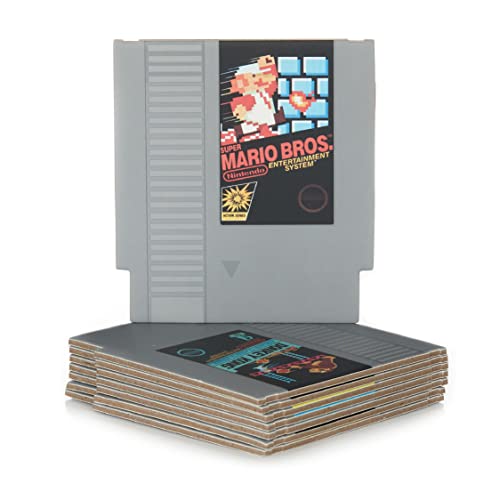
Do you love Nintendo? Then you have to check out this amazon NES cartridge drink coaster set!
This set includes 8 double sides drink coasters that look just like the classic NES cartridges.
This set is a perfect gift for the gamer in your life!
Unique System
The thing is, a lot of people will only be willing to own a PC, Xbox, or PlayStation for extreme gaming. By creating a unique console, Nintendo stands alone as a unique system.
Of course, you can use your main system to play a number of games and all that, but how about when you’re on a train, on your way to work? How about the times when all you want are some simple and exciting party games? Or what if you just want to have access to some of the most outstanding and sophisticated games there are? What you would be needing, in any of these cases, is a Nintendo Switch.
The Nintendo Switch does what other consoles cannot do, so instead of trying to compete with them and beat them, the Switch sticks to its uniqueness.
We all already know that Nintendo takes advantage of the one fact that they offer what others do not offer. Again, Nintendo knows that you’re coming for their game, and seeing as none of their big franchises is huge on photo-realistic graphics, they really do not need a lot of raw power.
Plus, their obsession with stylized graphics and their powerful art direction means that they can have great looking games without needing a lot of power. The Wii was really just an overlooked GameCube. The Super Mario Galaxy, on the other hand, has aged a lot better than any other game that was released around the same time. The Wii U’s Mario Kart runs at 1080p 60FPS, something that even the Xbox One and PS4 find difficult to achieve.
Regardless, we cannot always say that Nintendo consoles are underpowered even though they may not compare with others. They are actually powerful in their own way, especially as they offer great functionality.
Unique Games
From the very beginning, and up until now, Nintendo’s success has depended on selling high quality, interesting and unique games while other brands worry about numbers.
In the beginning, Nintendo was strong on the competition side. While the NES brought gaming right out of a crash, the SNES was a technological wonder with the mode 7 and Super FX chip. Plus, their Gameboy had the capacity to do portability in a way that no others could.
As soon as Gen 6 was out, the Xbox was showing the most realistic of all the graphics that were available at the time. The PS2 also was looking amazing. At this time too, Nintendo was working on the technically more powerful GameCube. There were the massive games on mini DVDs though that came with a portion of the storage of a dual-layer DVD.
Developers had a tough time working out how to find data for these. Even though Nintendo’s first-party library is super smart and works perfectly on the system, especially because Nintendo was able to optimize and get the most out of the game, the third-party library labored. The big AAA titles just couldn’t function on the console as a result of the disc size. Plus, breaking the games into many different discs was already history and no longer in vogue.
The poor sales of that system taught Nintendo that if they really wanted to make the games they wanted, backing down from the game wars was the best idea.
Unique Innovation
Going forward, Nintendo began reinventing ways to play games, be it touch screens, hybrid console, or motion controls. In the days of the Wii, massive amounts were sold in short periods of time leading to worldwide shortages. With this, Sony and Microsoft were pushed to start asking questions about how Nintendo regained relevance even after the GameCube had failed. Innovating motion controls enabled them to create their own way in the business. When Sony and Microsoft tried to copy the trick, they failed woefully because they had failed to optimize things to function correctly. Additionally, they had complicated techniques for registering the motions.
The Wii was their hidden special resource, but when the Wii U was announced, it came with problems. The marketing for Wii U was really terrible, and a lot of people still do not know it was a completely new console or a second version of the Wii. However, although it has been dead for a long time, the molding community realized that this machine had a lot of potential and may, as a matter of fact, be Nintendo’s most powerful system ever. This is because the capability of this machine can functionally emulate anything, the native compatibility of Wii and more are still being worked on even up until now.
Unique Switch
The Nintendo Switch now comes with motion controls that work faultlessly for the games. Even the execution is relaxed, and the system as a whole works beautifully. This system actually allows you to play Mario Odyssey right in your home and even to put the system in sleep mode. Plus, you can put the Joy-Cons back on the console, turn it back on while you’re going about your business, and still be able to pick up where you left off which is definitely something brilliant. A lot of us will agree that the console is a programming wonder and that even physically, it’s wonderful too.
Yes, it doesn’t have 4k visuals, but it can run almost everything at an easy 60 FPS, sometimes 30. Plus, it can keep a reliable resolution, whether in mobile or in docked form.
Conclusion
So, Nintendo actually does have consoles that are powerful in their own right. Even though they don’t have the best hardware, Nintendo put extra functionality into all of their products. This is proof that Nintendo systems can actually put out a lot of power.
No matter what system you prefer to play from Nintendo, if you look at their strategy, as well as their games that they have released, there is one thing that makes them stand out. That is the simple fact that they do not follow other companies. Nintendo is forging its own path in the gaming world, and although it is harder, there are many people who support them.
The community of gamers and fans that Nintendo has captivated are all very loyal and not only love the games and the consoles, but will pay anything to get their hands on one. This is why no matter where you go, you will see Nintendo products, and they will not be dying off anytime soon.