
*This post may contain affiliate links. As an Amazon Associate we earn from qualifying purchases.
Have you ever wondered what age Monopoly is for? Maybe you really love this game of chance but aren’t so sure about what age groups you can play the game with. Maybe you want your kids to know more about how to handle money but aren’t sure if they are old enough to really understand how the game is played. Well in this article we will go over all you need to know about what age Monopoly is for.
So what age is Monopoly for?
Experts say that the age Monopoly is actually for is for players ages 8 and up. Although younger players can play Monopoly if they are under 8, they will probably need quite a bit of help. There is also Monopoly Jr that is for players age 5 and up if you want your younger kids to learn about money or simply have fun.
If you want to know more about what age Monopoly is for you will want to continue reading this article. You can also watch this video all about the history of Monopoly.
If you love board or card games then you have to check out the game called Throw Throw Burrito! It is a fun fast-paced game where you throw squishy burritos at other people you are playing with! You can learn more by clicking here.
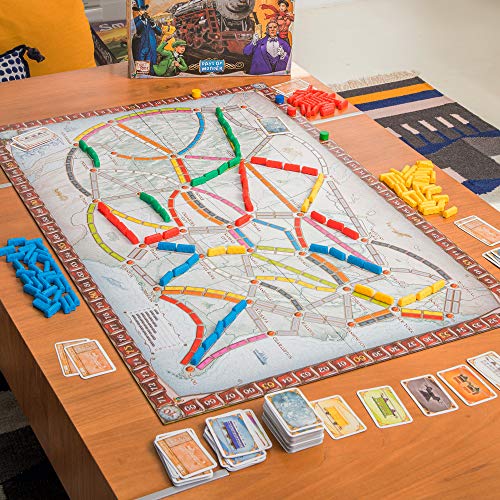
If you love games then you have to check out Ticket To Ride! This fast-paced board game will give you hours of fun with family and friends as you gather train cars and try to take over the board!
Ticket To Ride has many different variations as well so you can play across a variety of different maps.
The Basic Logic of Monopoly
In this game, as mentioned, the players can do all the dealing in the real estate marketplace to sell, buy, mortgage and rent properties and build buildings, hotels , residential apartments on their properties which they can rent out and make money out of it. Here, players who are in a winning or a favorable situation can buy other properties. Even if that meant that the seller of the properties ended up selling their properties at a much lower price than which they brought them, it is completely justified in the game.
This leads to some players getting into more and more comfortable positions and getting more and more control over the properties. As the game is ruled by chance of throwing dice, players having the most luck on that day usually will end up being the winner. The result leads to a sudden and dramatic shift in the fortunes of different players in the game with the losing player very quickly losing control over the game.
Who Can Play Monopoly?
Monopoly as a game could be played by nearly anybody who is capable of thinking with logic. It is played by adults and children alike and is an enjoyable pastime for both. For a child, playing Monopoly and Junior Monopoly games could be not only fun but a big way to learn many new things which would help it in the future life.
It is believed by experts that the right age to play Monopoly Jr games is from an age of 5 years. The experts further feel that the best age to grasp the basic learning concepts on Monopoly, is at least 8 years as the brain develops fast during this time. A child at this age can understand the basic explanation to theories of Finance and Economics in a very simple and playful manner. This also helps the child well throughout the rest of its life, teaching him important lessons in values and ways to make his future.This being said, it has been seen that children from the age of 4 years taking interest in this game which is perhaps the entry age set for it.
Experts are in disagreement with the exact matured age that a child is really ready to grasp the knowledge, because of the wide nature of the variables at play as discussed in details in the next section.
It is thought by many experts of the game that a particular age is necessary to understand the game and play to get its full benefits. Attention to details and concentration is two of the most important things in this game. Also one needs to have a basic understanding of the value of money and it’s dealings in elementary form. In this game, the child should also be matured enough to properly understand the basic ideas behind some very complex thoughts that can baffle even the adults. So for these reasons experts are in disagreement about the age.
What We Learn From Monopoly
We basically learn the following 6 very important points in finance. Always have surplus cash on hand. Always focus on cash flow of any functioning economic system. Always have patience because you don’t know what will happen even after 1 second, so have patience. Don’t give up hope till the last moment. Choose your assets very cautiously and cleverly Lastly, as the popular saying goes, don’t put all your eggs in the same basket.
Apart from these a bone of friendship and trust is built amongst young players playing the game. Friendships which can last a lifetime. Also, kids playing this game from a very young age, understands what team work and how to rely on others. They appreciate truth and transparency from a very early age.
The Ugly Side of Monopoly
Playing Monopoly gives us a lot of knowledge as well as a great enjoyment process. This being said it can also end up being a very competitive game. Some people have been known to lose control of their temper while playing this popular game. If people lose their temper in this game, it can become pretty intense. It can have a severe effect on the psychology of a player, particularly a kid if that happens to be the case.
The whole process might be briefly described as two friends playing a game but one wins the game by cheating. That makes the other player lose faith in the cheater and on people around him in real life too. Also, he is drawn to a life which is based on manipulations and betrayal. A good soul is lost and an evil one is brought to life.
This is why it is very important to know the personality of a child before making him an addict to the game. Also it is the need of the guardian to continually monitor their kids to check in and make sure that they are behaving normal and learning lessons properly.
The History of Monopoly
The Monopoly game first came into existence during the 1930s when there was great unrest happening in the USA. There was two-fold interest in designing the game. Leading as a game here the members of the family can play and enjoy themselves and as a mode for educating the masses at that time about the social structure, market policy, capitalism and the in equilibrium of the society. The game of Monopoly brought with it it’s own good and bad shares to the individuals who played the game and to the society in which they thrived.
On one hand, the game was used as a recreational source, played a lot by people across all age groups across all social sections. It brought a sense of joy and togetherness into the family which was one of the reasons why it was made but it also brought a lot of conflict between family and friends, these reactions were different depending on the specific person.. This, interestingly, was also a reason why this game was built. To test the social system, the relation between people on the verge of crisis and economic fallout. Indeed, one of the reasons to build up the game was to study the Economics of real estate marketplace as well as the study of individual emotions under another individual activity and monetary constraints.
In Monopoly, a player has the freedom and the right to do many different things. Amongst them they can buy, rent, loan and mortgage properties to make win the game. Here, players can not only get rent from their rivals, they can also increase their assets.
Conclusion
So now that we have talked a lot about Monopoly, we have learned that this game can help younger kids learn a lot about dealing with money in a positive way, but it can also teach kids how to be manipulative and greedy. Because of these reasons the age that Monopoly is made for ages 8 and up. That being said, use your best judgement in deciding if this game is a good game for your kids to play and if you think they will be able to fully comprehend how to play.