
*This post may contain affiliate links. As an Amazon Associate we earn from qualifying purchases.
Do you own a Gameboy and wonder if your games were worth anything? Maybe you recently went to sell your gameboy and realized that some of your games may be worth quite a bit of money. Well, we are here to help answer your questions and guide you through the most valuable games of the Gameboy.
So are Gameboy games worth anything?
Although most people would assume that since the gameboy was readily available that the games would not be worth anything they are wrong! Although not every game is worth a bunch of money there are some games that have sold for as much as $300! If trends continue though we have seen games like this posted for as much as $3500 in original packaging and new condition.
If you want to know more about the most expensive and rarest Gameboy games, you will want to keep reading this article. You can also watch this short video if you are like me and you don’t like to do a lot of reading.
Are you a huge Nintendo fan? Then you have to check out the Mario and Nintendo gear that you can get. Whether you want a Mario wallet, a Nintendo sweatshirt, or a classic NES hat there are plenty of choices to choose from. You can find them all by clicking here.
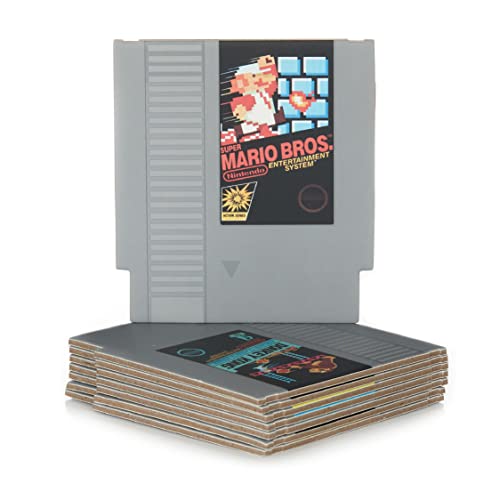
Do you love Nintendo? Then you have to check out this amazon NES cartridge drink coaster set!
This set includes 8 double sides drink coasters that look just like the classic NES cartridges.
This set is a perfect gift for the gamer in your life!
Why are Gameboy games valuable?
The original Gameboy brought a portable gaming addition to the people, and now it had a nostalgic place in the heart of people with its very own games. While its scarce games don’t make the best out of it, Gameboy chooses to touch the heights of success. There are still many hidden treasures that are still not found by many people when playing the Gameboy.
The Gameboy actually has a pretty valuable gaming library, when you look at all the games today/ This library is still around as most people did not get rid of their games for the original Gameboys, and still have them all together in a box or case. Some people even today still play their original Gameboy games every day. There was even a separate library of games for the Gameboy Color, as well as you could play the original Gameboy games on the Color.
Whether you are buying or selling the games, we want you to know how much your games are worth so you don’t overpay for a game, or undersell your games. Games normally have a couple of different price ranges. These vary based upon if the game is in its original packaging or if it has been used. It also will depend upon the condition of the game itself and how scratched or torn up the cartridge is for the game. Although when you were a kid you probably didn’t think about taking care of your games, it actually did. If your games are unopened and in perfect condition, they can sell for as much as 10x the value of opened games.
Rarest Classic Gameboy Games
· Spud’s Adventure
· Amazing Tater
· Mega Man V
· Sumo Fighter
· Jimmy Connors Tennis
· Kid Dracula
· Toxic Crusaders
· F1 Pole Position
If you own any of these games, you will be happy to know that they sell for over $100 each. If you happen to be one of the lucky gamers who own one of these games in original packaging, you could sell it for over $1000! So go ahead and start digging through your collection of games! You are definitely going to want to find out if you have any of these games!
Gameboy vs. Smartphone apps
Although many people today do not carry a handheld game with them they do carry their smartphone which has games on it. Sadly not very many games for a phone are anywhere near as addictive as we have seen with the Gameboy. The other advantage of playing a Gameboy over a game on your phone is the fact that when you play on your phone it seems like it is constantly going off and distracting you. You can go for hours without a notification, and the second you go to play a game, your phone will start to blow up. Although the Gameboy did not have the variety of games that you can find on a phone, for when it was released, the games available were far ahead of its time!
Although Gameboy consoles are no longer available, there is a way to combine the best of both worlds! You can simply buy this device, and you will be able to use your phone as a screen for the original Gameboy. This attachment for your phone will play any Gameboy game right there on your phone!
History of the Gameboy
The most reliable and worthy console of Nintendo was the Gameboy. Before the 3D glasses and touch screen; there was only Nintendo. Nintendo was the all-rounder of the gaming industry who conquered the globe by its incredibly functioned gaming consoles. The Gameboy was no exception of this either.
This excellent console was introduced to the world in 1989, and the battery power of this brick console was the greatest success of it. Throughout the ’90s, no other gaming console came nearer to this console box as it was the only handheld console of its time.
As the Gameboy evolved into sleeker and more colorful designs, it developed its strategies and earned success. Some of the games made by Nintendo made the best sales of its time. Some of the games sold millions of copies, while others just fell aside. Although many people today would love to see a relaunch of the Gameboy, It just sadly isn’t going to happen.
Because of the latest technologies and WI FI power, people spend a lot of time on their smartphones and laptops. Rumors about a Game Boy Classic Edition suggest that people still have this hope that they will be able to relive their long childhood car trips and games. Here is a short video explaining why the Gameboy classic should be the next classic console that Nintendo releases.
Although the Nintendo Gameboy came into existence over 30 years ago, this console was the most addicting console that anyone of its time had ever picked up. It seemed as though once you started playing the games on the Gameboy, you just could not stop.
The portable, two-tone brick initially invented the modern mobile gaming era when it hit the market in Japan on April 21, 1989. The legacy created leaves a mark in every heart, no matter if you still have your Gameboy in your old dusty drawer or not. The games of the console are something else and are loved by everyone who played them.
When it comes to portable handheld gaming, no other console could beat the mobile handheld gaming device by Nintendo. The gameboy earned success in terms of its functionality and addictive gameplay. Right after it made its debut in the market, it destroyed other competitors and grabbed the top spot among all the gamers of the world.
Everyone was talking about this game when it released, and everyone was playing it. We have even seen some people playing it today. Even though today’s generation will not appreciate the screens or games that we played on, they might get a chance to understand where today’s games all began.
Conclusion
Now that you know that your Gameboy games are worth something you will probably want to start looking to see what titles you have. You never know what you might come across and find to be valuable. Even the ones that are not extremely valuable should be able to sell between $10 and $30 depending upon game title and condition.