
*This post may contain affiliate links. As an Amazon Associate we earn from qualifying purchases.
Have you ever wanted to get a pool table, but you were not sure if your house would be good enough for it? Maybe you were going to put it in the garage, but you weren’t sure if it needed to be climate controlled. Well, in this article we will answer all of your questions as well as show you if pool tables need to be climate controlled or not.
So do pool tables need to be climate controlled?
Although some people do put a pool table in their garage, it will simply not last very long if it is not stored in a climate controlled area. A pool table should always be kept in a climate controlled area such as a house, or a garage if it is heated and has AC. A pool table should never be left outside, or in a storage unit that is not climate controlled either.
If you want to know more about pool tables and the need for them to be in a climate controlled space, you will want to keep reading this article. You can also check out this video to learn about outdoor pool tables and if you should buy one!
If you are looking to get better at playing pool one of the best ways to do that is by upgrading your pool cue. One of my favorite cues is the Viking Valhalla. It is available in a variety of colors and won’t break the bank. You can find it by clicking here.
What is a pool table?
A pool table is a table that is used to play a pool game. It seems like a field where you can play a pool game. Without a pool table, it is not possible to play a pool game. Besides this, the quality of the pool table also causes effects on a pool game. Some facts cause changes in the performance of a pool table. Including them, the climate is also one type of factor that causes a problem to the pool tables.
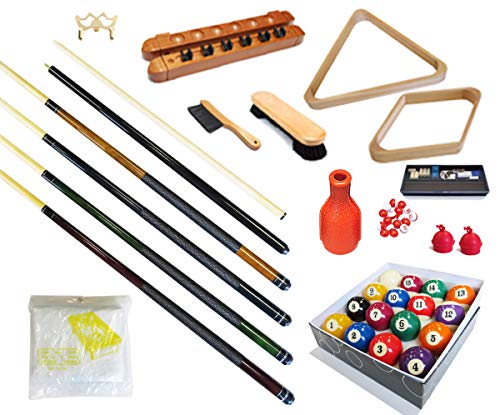
If you have a pool table then you need to get this accessory kit. It includes pool cues, extra pool balls, and all the gear you need to keep your pool table in tip-top shape.
If you are tired of your kids (or friends) ruining your good pool cue when they play then having these extra ones will keep that from happening (just be sure to hide your good one!).
Pool tables need to be climate controlled
Climate change has a great effect on the pool table. Sometimes it causes damage to the pool table. That means a pool table is fully climate controlled. Though some people have another conception about the climate change effect on the pool table, in my sense it has a great effect on the table. In fact, it is the number one concern.
It may cause a huge problem to our table. Basically, it depends on your location where you live. As we know, the temperature of different areas of the world is not similar at all. They are quite different from each other. Some of them have extremely cool weather. Whereas, some of the area has extremely hot and sunny weather. You may see that some areas have much humidity or dry climate. The differences in climate for different areas cause a different effect on the pool table. It also depends on the characteristics of the climate as well.
How does the climate affect the table?
- Bumpers
Climate change causes a different effect on the pool table materials. First of all, I can mention the bumper. As you know, the bumper of a pool table is prepared with rubber. Manufacturers use rubber to build the bumper so that it can produce enough bounce to the cue ball. That’s why the cue ball gets sufficient kinetic energy and runs on the table board. This bumper is normally created by using vulcanized rubber.
It is one kind of rubber that is prepared with a mixture of sulfur. It will not be affected by the temperature easily. Sometimes it can be seen that temperature has created a notorious effect on it. As it is the configuration of rubber that will be affected by the climate. The hot and sunny climate will cause the expansion of the rubber. The elements of rubber tend to be widened in a certain place and thus they get sloth. As a result, the whole quality of the bumper goes bad. Besides this, in cold temperature, the rubber elements compress in a particular shape. That’s why the quality of the bumper again goes bad.
Moreover, nowadays, as the manufacturer is continuing to build bumpers using cheap materials, it is very hard to keep the bumper in perfect condition. Besides this, I have seen several bumpers that have gone hard prematurely because of extreme temperatures. As there are many bumpers available, you can replace it, but it is very expensive as well.
- Wood
You can see the effects of climate change on the wood. As you know, the main product of a pool table is wood. Even, the majority of a pool table is prepared via wood. The effect of climate on wood is beyond description. As you know, wood tends to absorb moisture. As a result, it expands in width and height. If there is much moisture in the atmosphere, then your table wood may begin to actually expand. That’s why it may go bad. Besides this, in the hot temperature, there will be a lack of moisture. You can also see that there is high humidity. It will also cause changes to the wood. As a result, it will affect the wood of the pool table. So, we should be conscious of the climate change effect on the pool table.
When a manufacturer is preparing a pool table, he should provide scope for expansion to the pool table. Otherwise, in the expanding time, it will get damaged. Besides this, you should not keep your pool table directly on the concrete floor. Otherwise, it will absorb all of the moistures and cause damage. The legs, rails, and frame of the pool table are mostly prepared through the wood. That means climate has a great effect on the pool table.
- Leather
The Climate also affects the leather pockets. As the leather pockets of a pool table will dry out in arid climates, you should take care of it. That’s why you should not keep it near to the sun. You will want to maintain the temperature so that your leather pocket remains good.
- Table felt
The table cloth of a pool table is also climate controlled. It is a high-quality woven cloth. It contains high-quality wool content. If there is high moisture in the atmosphere, then it will relax and loosen up. If the weather is damp, the tablecloth will grow mold. That’s why the quality of a tablecloth will change. It will harm a pool table. So, you can say that the tablecloth of a pool table is climate controlled. Replace it soon otherwise, the full quality of the pool table will get damaged.
- Slate
The effect on the slate is also quite high. Even, players are more concerned about it. It is rock and was an important part of a mountain. For this, you don’t need to think so much about slate. But still, there is a huge problem. It will absorb cold and moisture. After that, it will transfer the moisture onto the cloth. Thus, the cloth will get damaged. In a word, it can be said that the quality of a pool table fully depends on the climate. As climate causes several effects on the pool table, we need to think about where we are putting the table.
Conclusion
Now that you know all the things that the climate can affect on a pool table, you can see why it should always be kept in a climate controlled area. You do not want your table to break very easily or not last long because it was not taken care of. This is why it is important to always take care of your pool table and make sure that it is kept in a climate controlled area.