
*This post may contain affiliate links. As an Amazon Associate we earn from qualifying purchases.
Are you looking at getting a pool table, but you are worried that you don’t have any place to put it? Maybe you have a man cave in your garage, but you aren’t sure if a pool table will fit? Well, in this article we will go over everything you need to know about a pool table and how big they are.
So will a pool table fit in a garage?
Although there are different size pool tables, most pool tables will easily fit in a garage with plenty of room around it to play. If you do have a small garage though, you can get a smaller pool table so you still have plenty of room to play.
If you want to know more about pool tables and their sizes, you will want to keep reading. You can also watch this short video to see what size pool table is right for you.
If you are looking to get better at playing pool one of the best ways to do that is by upgrading your pool cue. One of my favorite cues is the Viking Valhalla. It is available in a variety of colors and won’t break the bank. You can find it by clicking here.
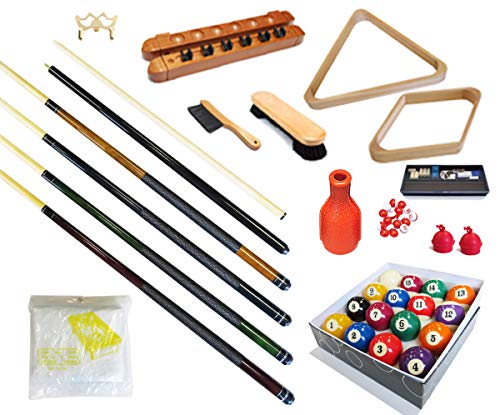
If you have a pool table then you need to get this accessory kit. It includes pool cues, extra pool balls, and all the gear you need to keep your pool table in tip-top shape.
If you are tired of your kids (or friends) ruining your good pool cue when they play then having these extra ones will keep that from happening (just be sure to hide your good one!).
Type of Pool Table
- English Pool Table
There is a three-room size recommendation depending on cue length. If the table measures 50 inches in width and 90 inches in length you will need to add room for walking around the table and taking your shot. This means that if you have a 43” cue, the garage must be at least 127” in width and 166’ in length. For a 48” cue stick, you will need 176” in length and 137” in width. For 57″ cue stick length, you will need as wide as 156” wide and 194 “ long for the table area.
So if you will put a 7′ pool table, the garage must be at least 156” wide and 194” long to accompany cue sticks from 43″ to 57″. This means If your garage barely has this measurement then you can just have a 7ft pool table. If you want an 8 foot pool table, then you will either need a bigger garage, or shorter cue sticks. Some people will also move the table so it is not centered so you can use a full size cue on 3 sides but then on one side you will need to use a shorter one.
- Snooker table
Snooker tables may come in different sizes as well. It has more sizes than the other two pool tables we will discuss.. They are lower in height, and have smaller pockets compared to the previous pool tables mentioned above. If you have a cue stick that measures 48” and you have a snooker table that measures 8’ then a garage size of 16 feet by 12 feet is perfect for you. If you have a 52’’ cue sticks with the same snooker table measurement, you will need a garage that has a dimension of 17’ by 13’. If you have a garage that measures 17.5 feet by 13.5 feet, a cue stick of 57’’ and 8 ft snooker table will fit easily into the garage with plenty of space around it to play.
For a 9 ft snooker table, you will need a garage as large as 17 feet by 12.5 feet to 18.5’ by 14’. This garage size can cater to a cue stick that measures 48″ to 57″ respectively.
If you want a 10 foot table, on the other hand, it needs a garage that measures 18 feet by 13 feet to accommodate a 48″ cue stick. If you use a 52″ cue stick then a 10 foot snooker table will need a garage that measures wider and longer than that of a 48″ cue stick. For a 10 foot table, your garage must have at least 19 feet by 14 feet. While for 57″ cue sticks, the garage must measure 19.5 feet by 14.5 feet.
This amount of room will give you plenty of room to move the longest cue stick possible for a snooker pool game. Since the snooker pool table is larger than the two mentioned above, it can have a pool table size that is all the way up to 12 feet long! If you wish to have this size of pool table, then you will need 20’ by 14’ garage size for a 48″ cue stick. You will need a 21 feet by 15 feet garage size for a 52″ cue stick, and a 21.5’ by 15.5’ for a 57″ cue stick.
.
- American Pool Table
American pool tables are generally larger than English pool tables. A standard American pool table is 9 ft long while the English pool table is only 7ft. However, if you will have a tournament size pool table. For a 7’ American pool table, if you will use a 43” cue stick. This will only make your recommended garage size around 14’ by 10.5’.
You can have more room than that, that is simply the minimum that you will need to play around the table with ample space. That is only enough for players to move their 43” cue sticks though. If you are using a 48” cue sticks, your garage must be at least 15’ by 11.5’ in size. If you’ll have a longer cue stick like a 57″ cue stick, then you will need a garage that is 13’ wide and 16’ long. If your garage is 15’ by 11.5’ then an 8′ pool table is good for you. You will want to make sure that your cue stick is no longer than 43″.
If you want a tournament size pool table, you will purchase a 9 ft pool table. If you do get a 9’ table, and you want to have plenty of room to fit every single size of pool cue then you will need a garage that is at least 19’ long and 14’ wide. An amperage single car garage is 20’ long, but it is normally only 12’ wide. This will make a 9’ pool table a little cramped unless you angle the table diagonally in the garage. Most people have a two car garage though which is normally 20’ long and 22’ wide. This is enough room to have a full size pool table as well as a seating area, a bar, and a tv to watch all of the sports you can imagine.
Conclusion
If you have a garage that has the same size as what is mentioned above, then a pool table can easily fit in your garage. However, if the size of your garage is not mentioned above then I highly recommend that you make a garage with the same size required for your chosen pool table. The larger the pool table the larger the garage size must be. Thus, your garage must be bigger to accommodate a good pool table size for your chosen pool game.
There are two important things that you should remember. They are, when choosing a table, make sure you know the size of your garage to avoid waste, and secondly to make sure to consider all the sizes of the cue sticks that you will use.
There is nothing more heartbreaking than buying a brand new pool table and getting it set up in your garage only to have to use a tiny stick because you did not accommodate for room to make the shots around the table. So go ahead and measure your garage, and put that pool table you have always dreamed of in it.