
*This post may contain affiliate links. As an Amazon Associate we earn from qualifying purchases.
Have you ever wondered what makes some pool tables more expensive than other pool tables? Maybe you know that there are pool tables that are not made with slate, but you aren’t sure how to tell the difference?
Well, in this article we will go over everything you need to know about pool tables and how to know if they are made from slate or not. So how do you tell if a pool table is made from slate?
The best way to tell if a pool table is made of slate is by trying to pick up a corner. If you can easily pick up the pool table then it likely is not made of slate. You can also tell whether the table is slate by the sound that the pool ball makes when it bounces on it.
Some pool tables even allow you to see the slate pieces from under the table.
If you want to know more about pool tables and knowing how they are made with slate or another material, you will want to keep reading.
If you are looking to get better at playing pool one of the best ways to do that is by upgrading your pool cue. One of my favorite cues is the Viking Valhalla. It is available in a variety of colors and won’t break the bank. You can find it by clicking here.
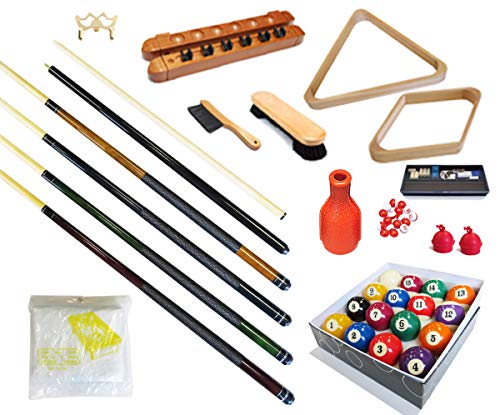
If you have a pool table then you need to get this accessory kit. It includes pool cues, extra pool balls, and all the gear you need to keep your pool table in tip-top shape.
If you are tired of your kids (or friends) ruining your good pool cue when they play then having these extra ones will keep that from happening (just be sure to hide your good one!).
How To Tell The Difference Between Wood And Slate Pool Tables?
If you love playing pool games, it is easy to notice the material used in making a pool table. You will easily be able to know if it is wood or slate. For those who are consistent in playing pool at the clubs or bars, they know they can differentiate whether a pool table is made from wood or slate.
However, if you are new to playing pool, marking the differences in these materials may be challenging. Below, we will see all the qualities of a slate pool table.
These include their price, quality, gameplay, durability, cost of maintenance, weight, and even portability. Once you know everything about a slate table, you will easily be able to tell what is not a slate table.
1. Difference In Price
Generally, slate pool tables are expensive, and this high price is one way to tell that a pool table is a slate. Their prices are high because the tables are made of wood bodies that cover the entire table and then a slate top.
Even though slate tables are costly, they have a higher demand than non slate tables.. For this reason, the current sports markets are ballooning with slate pool tables rather than the wood pool tables.
The wood bodies make the slate finish look very attractive. That is why the price for a new table with slate ranges from around $1000 to as high as $30,000.
The price may seem very high, but purchasing this table is worth every penny spent from your pocket. You will not regret it as the quality of one of these tables is something that will last forever.
2. How The Pool Table Plays
Any platform of slate will give better results with regard to playing the game. The quality results are because the slate has 100% flat grainy rocks that are parallel and original.
With all these materials, playing pool on the slate table makes the ball roll smoothly and quickly. This is why slate tables make the best thing to play pool on.
This quality is not common for the pool tables made from other materials. Slate makes the game effective as the grains are blocky and randomly sloped. The smoothness of slate, makes the pool balls move across the table effortlessly.
The table is good for the newbies who want to enhance their pool skills, as well as anyone else who wants to play professionally.
3. How Portable Is The Pool Table?
Slate pool tables are quite heavy and not easy to carry around. It is almost impossible to even move them a few inches, and if you are looking for an easy choice to move around with, this may not meet your needs.
If you must move them, you will need the help of roughly three people. Recently, some manufacturers have designed some pool tables with three different slates.
They are rising to fame as they have better quality and more stability in the gameplay. On average, a slate pool table weighs around 550 pounts to more than1200 pounds!
This is why there is difficulty in lifting them. If you have a slate table, you will not want to move it from where it is set up as it is extremely heavy.
4. Pool Table Quality
When it comes to quality, the slate pool table has a competitive advantage. This table cannot be compared with a pool table made from a different material.
Slate offers a better quality performance to play on. It is their quality that improves their durability and makes them costly. They are very accurate, and if well maintained, they will last longer than your entire life.
This is why slate pool tables are of high demand and remain among the most popular pool tables.
5. Pool Table Resistance
Just like most natural stones, the slate tiling is usually sealed to make it more repellent to water and to prevent it from scratching and staining. All of this makes the slate pool table resistant to liquid, spills, and scratching.
If a bad spill happens, you only need to change the table cloth or felt, and you are good to go. This feature ensures that the table grows old with you.
Since it is purely natural to its core, you will be guaranteed an incredible gameplay experience. Whether it will be struck or scratched, the slate table is designed to offer a satisfactory play.
6. Pool Table Cost Of Maintenance
Unlike most pool tables, the slate pool table has a lower cost of maintenance. Being made of robust natural materials, maintenance is not strenuous. Additionally, because of its high level of resistance to liquid spills and scratching, be sure that the table will grow old with you.
Just as I mentioned earlier, your only work will be to change the top felt as needed, and you are good to go. If you are a pool player with a hectic schedule, you will definitely want to go for this option and avoid all the worries of taking care of your pool table every single day.
7. Pool Table Leg Construction
The whole weight of a slate pool table settles on its legs. If you want to identify a quality slate pool table, the leg construction is usually stable.
For most of them, the construction is of either two pedestal-style legs or four individual legs. When the pedestal-style legs are used, they are usually framed with sturdy solid material.
On the other hand, if the four different legs are utilized, the manufacturers ensure that the legs have sufficient strength to support the heavy weight of the table. There is a specific method in which the legs of a slate pool table are constructed.
This method of construction helps to keep the entire table rigid.
Conclusion
The slate pool tables are always the best option if you can afford them. From their quality, durability, good gameplay, reliable construction, and many other factors, you are bound to enjoy playing pool on one of these premium tables.
If you have been looking for the combination of resistance and quality, the slate pool table has got you covered. It is what you have been missing.
Having sufficient knowledge to help you know how to tell if a pool table is slate is beneficial. The knowledge you now know from this article will help you make the right choice when you are in the market to make a purchase.
All the above factors are crucial, and failure to identify them may lead to a poor decision.