
*This post may contain affiliate links. As an Amazon Associate we earn from qualifying purchases.
Have you ever wondered what the top of a pool table was made out of? Maybe you purchased a used one, and you needed to move it, so you found that there were some pretty heavy pieces on the table. Many think that these heavy pieces are solid pieces of marble because of their weight. Well, if you want to know what these pieces are made out of, you will want to keep reading.
So are pool tables made of marble?
Although there are heavy pieces of stone on the top of the pool table, they are not normally made out of marble. They are actually made out of slate. The slate works better than marble as it is hard, and will not break when balls keep hitting it over and over again.
If you want to know more about pool tables and what they are made out of, you will want to keep reading. You can also watch this short video that will show you step by step exactly how a pool table is made and assembled as well as what makes up the table.
If you are looking to get better at playing pool one of the best ways to do that is by upgrading your pool cue. One of my favorite cues is the Viking Valhalla. It is available in a variety of colors and won’t break the bank. You can find it by clicking here.
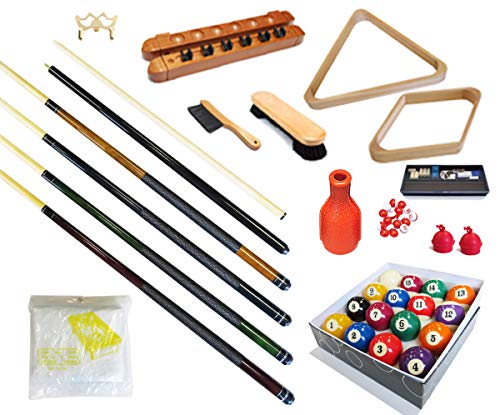
If you have a pool table then you need to get this accessory kit. It includes pool cues, extra pool balls, and all the gear you need to keep your pool table in tip-top shape.
If you are tired of your kids (or friends) ruining your good pool cue when they play then having these extra ones will keep that from happening (just be sure to hide your good one!).
Why is slate used for pool tables?
Although many people think the tops of pool tables are made of marble, they are actually made of many different materials. Unfortunately at this time marble is not one of the items used to make a pool table. Slate is better than marble because it is hard but not too hard.
Slate used in pool tables is mud and clay (shale) that has been changed by heat and pressure somewhere down in the earth. These minute grains of silt and clay in slate are level and equal. This quality isn’t found in rock or Marble.
Slate is a sharp stone made of numerous minerals, including quartz, earth, and mica, with a fine grain. It is perfect for pool tables since it normally parts into full, level pieces. Another good reason slate is used is because it can be expertly ground and cleaned into a superbly level surface. While slate is more substantial and more costly than wood, slate guarantees that the playing surface stays smooth and steady. Wood, just as tabletops produced using synthetics, can twist only after a little bit of use. Since it is so reliable and known to last, numerous makers will give a lifetime guarantee on the slate if you purchase one of their pool tables.
Non-slate pool tables are more affordable than those that are made of slate. Nomn slate tables are normally made of plywood. Sometimes the wood will be very thick where only someone who plays pool a lot will notice, while other times the wood will be thin and extremely flimsy. Even though these wood tables are extremely cheap, they are still fun for people to play on. Especially if the people playing are just kids.
How do I know if I have ever played on a slate table?
If you’ve ever played pool at a club or a pub, you’ve more likely than not played on a slate table. For anyone of you hearing the term for the first time, this means that the surface you are playing on is an actual slab of slate with a cloth over it and a moderate to a high-quality table built around it. Slate tables tend to be better quality and therefore cost more because a slate top is more expensive than a wood top.
However, If you do play on a wood top, even if it’s expensive, you will not be able to get the same level of quality as slate. On the other side, non-slate tables are more affordable, and that can mean you can afford one in some situations when you can’t afford slate. If you are interested in purchasing a table that is not made of slate because you just want an affordable pool table, this is the best place to get one. When slate is not used, there is some other type of material that is in its place. The ones most commonly used include station, which is a type of synthetic material, or wood.
You will find multiple qualities when it comes to non-slate tables. It is not beneficial to get a shallow cost pool table that is non-slate if it is not long-lasting. The better you know about the non-slate pool table, the better choice you will make.
If you play your pool table often, then non-slate will not be beneficial for you. It changes its shape and bends down with time, and just simply will not last very long. It is also very easily damaged with any sort of moisture or hard hit with the balls.
If you do own a non slate table, then you will want to be very careful not to spill any sort of drink or water on it. Even though you can replace the felt, the wood underneath will begin to warp and make the table useless.
The decision to buy a non-slate table is one you need to consider carefully. If you don’t want to spend much and just want to enjoy its perks from time to time, then you can try the non-slate pool tables, but if you plan on using it regularly, you are better off to spend some money and get a good quality table.
Slate is additionally increasing a fan base, as it is progressively sturdy, with legitimate support. A pool table with an Italian or Brazilian record playing surface can keep going for ages.
A slate for a run of the mill pool table weighs between 400 to 600 pounds, or approximately 180 to 270 kilograms, and is normally three quarters to one inch thick. To make transportation simpler, and to lessen the danger of crack during travel, a slate table top is regularly split into three pieces.
When the slate is reassembled, care must be taken to guarantee that each of the three sections coordinates consummately, and the table is level. While one- slate tables are accessible for procurement, most purchasers incline toward a three-fragment table since it’s a lot simpler to move it. If you do have a three piece slate table top, an expert installer can make the slate seem exactly as a one-section slate table top.
What are the sides and legs of a table made from?
The other significant part of pool tables is wood. Although some cheap tables use plastic or metal, real quality pool tables are made from wood. They are cut exactly to length and bored out exactly where needed by a cnc machine. The cnc machine uses a computer to precisely make every pool table 100% accurate.
Conclusion
Now that you know pool tables are normally made from slate and not marble, you can be sure to tell your friend that you were right. If you are looking to buy a pool table, you will want to decide how often you are going to want to use the table so you can decide what type of table you are going to buy.
Although most people recommend buying a slate table as they will last forever, sometimes if you are purchasing for children you can purchase a cheap wood one. If you do go this route it is one less thing you have to worry about as if it gets damaged it is not that big of a deal as it was not anywhere near the price of a slate one.
No matter what table you end up buying, you are bound to have fun playing on it, and making many great memories while using it.