
*This post may contain affiliate links. As an Amazon Associate we earn from qualifying purchases.
Are you getting a pool table, and wondered if it should be put on a rug? Maybe you have seen some pool tables placed on rugs instead of on a hardwood floor, and you wondered if that was something that you should do as well. Well, in this article we will go over everything you need to know about a pool table and if it should be on a rug.
So should a pool table be on a rug?
Although a pool table does not have to be on an area rug, most people place their pool table on one if they have a hardwood floor to avoid gouging and damaging the floor. It is entirely a personal preference whether you place your table on a rug or not.
If you want to know more about pool tables being on a rug, you will want to keep reading. If you do decide to get a rug, you will definitely want something that will look good in your room and complement the decor as well as the table itself. This is the best place to get a rug that would go under your pool table.
If you are looking to get better at playing pool one of the best ways to do that is by upgrading your pool cue. One of my favorite cues is the Viking Valhalla. It is available in a variety of colors and won’t break the bank. You can find it by clicking here.
What Is Pool?
Pool is a game of cue that is played on table tops. The objective is to put all the object balls into the six ball pockets situated at the corner and middle of the length of the table with the help of the pool cue with minimal hits. It used to be played outside on the green grass and used to have bigger balls and mallets as instruments of the game. However, with time the game transferred inside and retained the green on the table tops as an homage to the green grass outside on which it was originally played.
The pool table has to be set up in a particular way so that all the sides of the table are within the reach of the player. It also cannot skid over the floor and thereby leaving gauges or worse, breaking off a leg or two of the table by slipping on the cement floor. It has to be stable and steady and not slide off on the floor with a solid hit of the player’s body. It has to stand majestic just like the game it plays and that includes no skidding or slipping on the floor of the room where it is played.
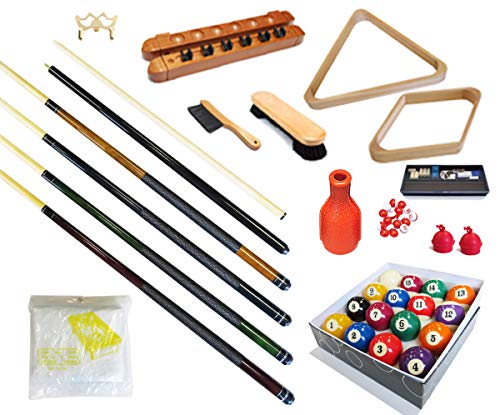
If you have a pool table then you need to get this accessory kit. It includes pool cues, extra pool balls, and all the gear you need to keep your pool table in tip-top shape.
If you are tired of your kids (or friends) ruining your good pool cue when they play then having these extra ones will keep that from happening (just be sure to hide your good one!).
Should a pool table be on a rug?
What is to be done then to stop the table from just running off? Should you screw in the legs into the floor itself? No, that would merely help in breaking the legs. Should we glue the table to the floor perhaps? No, this provides a similar dilemma. Avid enthusiasts say that there is nothing better for a pool table than a hardwood floor to keep the trappings of the magnificent game and render it impossible for the table to move as well. As it is, the wooden cabinet that makes the table is rarely touched to be pushed off its course so as to keep the slate levels accurate.
Everyone loves having expensive hardwood floors to match the feelings that a pool table enunciates to the world. This leads some people to wonder if there is a cheaper alternative. This is where an area rug came into play. Having a rug will allow your table to be a focal point of the room as well as keep your hardwood floors safe from damage from the pool table. Some people do prefer to leave the table legs directly on the hardwood floor, as they do not like the rug look. Most people want to protect their floor which is why they go for a rug.
Rugs to go for
When something as heavy and large as a pool table is in a room, there must be real consideration given to the area of the floor covered below the table. A pool table can easily be 1,000+ pounds. Add to that the other furniture in the game room and appreciative guests roaming about and you would need a hefty and heavy lifting floor solution for that room. Support beams below the floor are sure to help, but the fact remains that this is going to be an ultra heavy room to deal with.
Hardwood floors are heavy as well as cement floors, but to match the aesthetics of the room something must be chosen. Cheap alternatives will not remain cheap if all it is going to do is destroy the things in the room like a perfectly levelled pool table. If you are unsure of the weight handling capability of your room, you can always consult an engineer and go through the process of placing the pool table in the room. You do not want to go through the entire process of getting a pool table and in 24-48 hours it ends up falling through the floor because it was not strong enough to hold the table. Once you are sure the room will hold the table, you can concentrate on the covering options available to you at that time.
What Should I Know Before I Get A Rug?
There are a few factors that you should be aware of before installing a carpet or rug below their pool table. Those factors are that pool tables must remain level even after the addition of the carpets. That is a typical rule of the game. Without a completely level table, a game on the pool table can be deemed impossible. Carpet seams, though nearly invisible, can change the level of a table very badly, listing one way this end and other way the other end. Thus, when carpets are used, they must be settled well into the floor so that the level of the pool table remains steady.
Carpets, even the thin ones, have a foam lining that helps absorb the moisture of the atmosphere and otherwise and increases comfort for the feet that walk all over it. When a pool table is placed on a carpet, the foam starts to deflate under the legs or points where the wooden cabinet touches it. One has to keep realigning the level of the table continuously for a week so that the table does not lean unnecessarily to the side.
Whether you go the way of the pool tables or the way of the hardwood floor, you will have to work at leveling the table very very carefully and very very frequently. This is a good maintenance tactic if you want a long life for your pool table. Set up your levelling tools by your table and keep checking to make sure that you are at the perfect straight level to play your game and you are golden.
Conclusion
In conclusion it can be only said that rugs are preferable over anything else so long there is adequate maintenance done periodically on the level of the pool table. Whatever other décor or decisions an owner might go for, putting rugs under a pool table is an excellent choice anyway. There is validity to the decision and beauty in the execution and what more could anyone ask for?
Even though some people prefer the natural look of the pool table against their floor, this does not make their choice to not get a rug a bad choice. It is simply the decision of the owners if they prefer to have a rug under their pool table or not.