
*This post may contain affiliate links. As an Amazon Associate we earn from qualifying purchases.
Have you ever been playing pool and wondered if the pockets were the same saze as a different table you played on? Maybe the table you are playing on looks totally different and the pockets look different as well.
So are pool table pockets universal?
Although there are different sized pockets depending upon the table size, they are all universal in the fact that they are the same size in relation to the size of the table you are playing on. For instance; if you are playing on a 4’ table the pockets would be smaller than the pockets on an 8’ table. The pockets in America are also a different size than the pockets in other countries on their pool tables.
If you want to know more about pool tables and the pockets of them, you will want to keep reading this article. You can also watch this video showing the difference in pocket sizes as well as how different manufacturers make their pockets easier for the ball to go into than others.
If you are looking to get better at playing pool one of the best ways to do that is by upgrading your pool cue. One of my favorite cues is the Viking Valhalla. It is available in a variety of colors and won’t break the bank. You can find it by clicking here.
What is pool?
Pool is a general term alluding to a wide range of billiard games, with the most famous games such as nine ball and eight ball pool as well as others. Nine-ball is played with nine balls in a precious stone rack named one through nine. Eight ball is played with fifteen shots in a full triangle rack.
Pool is a generic name for games on six-pocket tables of different lengths (7′, 8′, 9′) that incorporate famous games. Some of these games are eight-ball, nine-ball, and straight pool. All of these games are played on a table with six pockets; one in each corner and one on each of the sides of the table.
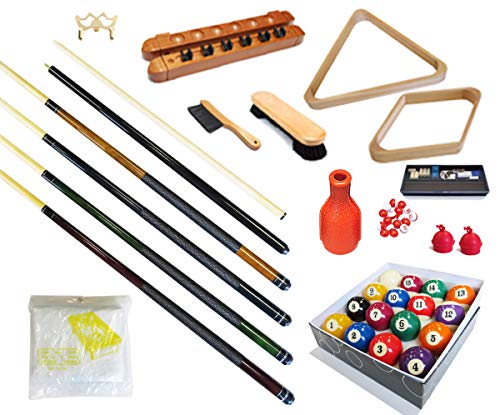
If you have a pool table then you need to get this accessory kit. It includes pool cues, extra pool balls, and all the gear you need to keep your pool table in tip-top shape.
If you are tired of your kids (or friends) ruining your good pool cue when they play then having these extra ones will keep that from happening (just be sure to hide your good one!).
American Pockets and Cushions
With the bigger ball size on American tables, the pockets are additionally bigger in America. Pockets on an American tables are sufficiently wide to fit two American pool balls in the ‘jaws’ of the pocket next to each other. The American pool uses a bigger table with bigger pockets. The rules are also different from the players trying to use the same set of balls.
English pool is played on a small table with one player shooting for yellows and one player shooting for reds before the final black. They are very different games.
American pool tables are commonly bigger, beginning at 7ft and going up to 9.5ft. As referenced over, the pockets are considerably bigger than in the English pool, to suit the bigger 2¼” balls.
The corner pockets are full and inviting, making long shots along with the pads simpler than on an English table. Be that as it may, the middle pockets are not as open as on English tables; they have a “straight-cut” style, as opposed to the opening at a point. American pool tables likewise will, in general, have quicker material fitted, making for a faster game.
These inconspicuous contrasts lead to a difference in playing styles, making the English pool somewhat increasingly slow and attentive while the American pool is more immediate and additionally energizing.
The state of the pocket is likewise calculated, nearly to the degree that the pads look like cutting edges against the surface. In most occasions the balls will find their way into the pocket. On the flip side of this, shooting into the side pockets is made increasingly troublesome, requiring a more straightforward way to deal with the pocket.
It’s anything but difficult to perceive any reason why English balls tend not to be utilized on American tables as well. Putting an English ball into the opening of any of the pockets will show you exactly how much smaller the English pool balls are by examination. The smaller balls nearly get lost as they fall into the pockets! Similarly, the taller contact point on the pads frequently implies that smaller balls won’t react appropriately, due to reaching the pad at a lower position than planned.
American-style pool table pocket openings have vast straight-cut opportunities, and it is the standard pool table style for competition 8-ball and 9-ball.
English Pockets and Cushions
Much the same as on an American table, the size of an English pool table pocket is smaller in size, because the balls themselves are smaller. Likewise, only like an American table, English pockets are generally permitted a similar measure of a room into the pocket comparative with the ball size.
English Pool Tables are 6ft or 7ft, which is the standard size found in bars and clubs around the UK. The balls are 2″ in format, and on coin-worked pool tables the signal ball is 1 7/8″.
Red and yellow balls are the most regularly used, however many lean toward the vibe of American-style solids and stripes. Since the balls are smaller in the English pool than in American, the table pockets are correspondingly smaller. The style of the game likewise implies that the “jaws” of the corner pockets are smaller, while the middle pockets are more open than American ones, which permits you to shoot from a more tightly edge
The pocket shape is likewise discernibly unique. An English pocket has a discernibly smoother passage into the pocket than the more straight and rakish American pockets. Practically inverse to an American table, English corner pockets are significantly progressively hard to shoot into down a rail inferable from the edge of the pocket. Then again, side pockets are considerably simpler to pull on an English table! The absence of a progressively positive section makes the side pockets the best pockets for people to shoot for.
English pads are additionally a somewhat extraordinary shape. A level, the elastic pad is standard on an English table, with the fabric at that point getting at an edge down to the playing surface.
Conclusion
So now that we know, British and American pool tables contrast for the most part in appearance. These distinctions make contrasts in gameplay understanding. If every now and then you play in a bar or club, you would actually be ok playing on a british table. Although very few places in the United States have a british table, they are fun to play on.
American pool tables are more accessible and now they even have smaller versions of the table for younger people and smaller people to play on that have never played before. This helps the next generation learn how to play pool way before they can lay on a 9’ table.
English tables offer more tests for those needing to sharpen their abilities. The American-style pool table is generally what is used around the world though.
If you plan on playing in a competition, you will need to practice on an American table. Because you live in the United States, you probably play on an American table all the time. This means that you most likely didn’t even know there were different sized tables and pockets and rules for different parts of the country.
No matter if you play for fun or want to one day be a championship winner, you have to start somewhere, and while you play the most important thing is to simply have fun.
Now that you know the pockets of the tables are different sizes you can be sure to always play on the official tables with the right sized pockets so you keep a consistent game.