
*This post may contain affiliate links. As an Amazon Associate we earn from qualifying purchases.
Have you ever wondered how tall a pool table is and if there is a specific height for the table? Maybe you have played pool on a table that seemed shorter than other tables and you are wondering if there is a regulation size? Well, in this article we will go over everything you need to know about pool tables.
So what is the height of a pool table?
A regulation pool table can be no shorter than 29 ¼” to 31” off the ground. These tables no matter how long or wide they are, are not able to be outside of these standards. Any table outside of these standards is not considered a regulation table.
If you want to know more about the height of a pool table, you will want to keep reading. You can also check out this video to see exactly how a pool table is made.
If you are looking to get better at playing pool one of the best ways to do that is by upgrading your pool cue. One of my favorite cues is the Viking Valhalla. It is available in a variety of colors and won’t break the bank. You can find it by clicking here.
What is considered a pool table?
A pool table is a bordered table on which cue sports are played. Cue sports include any game that is played with cue balls and a stick to hit them with. All pool tables (regardless of whether for carom billiards, pocket billiards, pyramid, monopoly or snooker) give a level surface typically made of quarried slate. The table is then secured with fabric (normally of a firmly woven worsted fleece called baize or felt). It then has elastic pads that are more commonly referred to as bumpers or rails. The entire surface of the table is raised off the floor by legs. Some games have a different table design, but they are all made in a similar fashion.
A pool table, or pocket billiards table, has six pockets. It has one at each edge of the table (corner pockets) and one at the midpoint of every one of the more extended sides (side pockets or centre pockets).
Pool tables often are produced in different sizes. This is known as the length of the table, and it can be 9 ft (2.7 m), 8.5 ft (2.6 m), 8 ft (2.4 m), or 7 ft (2.1 m). In all cases, the table is rectangular with a 2:1 ratio (e.g. 9 × 4.5 ft). All of the tables no matter how long and wide they are are only allowed to be 29 ¼” to 31” off the ground.
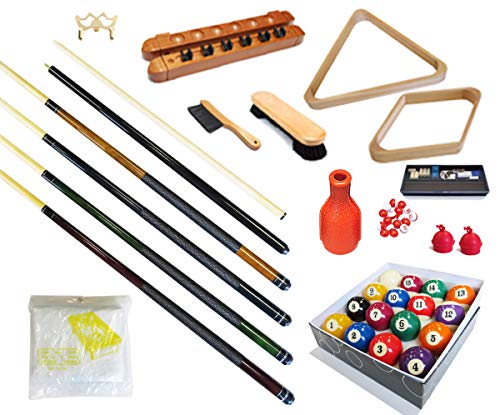
If you have a pool table then you need to get this accessory kit. It includes pool cues, extra pool balls, and all the gear you need to keep your pool table in tip-top shape.
If you are tired of your kids (or friends) ruining your good pool cue when they play then having these extra ones will keep that from happening (just be sure to hide your good one!).
Are the pockets of the table important?
Pockets are an important part of a pool table. What do you need to know about them? Pockets are usually rimmed at the back with calfskin or plastic generally have drop pockets, which are little containers beneath each pocket to get the balls. Most present day pool tables may rather utilize a ball return framework. This is a progression of drains inside the table, which channel the balls into an assortment compartment on one side of the table, along these lines to the ball return on a bowling alley.
On a mint piece worked table, the balls are stored inside a blocked off compartment window until the table is paid. Once the machine accepts the money, the balls will be discharged into the assortment chamber, while the prompt ball is typically isolated into its own ball return. A weakness to drop pockets is that if an excessive number of balls go into a similar pocket, it will top off the repository and keep additional balls from going in that pocket. This can be annoying if you are in the middle of a game to have to stop and move the balls to other pockets on the table.
Casinos have different types of monopoly games that are used to generate money. More so, these monopoly games use pool tables. The pool table length you would most likely find in this type of casino is 8.5 feet. People who play casino monopolies are not people who go there with the mind of having fun. They are only there to gamble and make money. It is not only the gamers that make money but also the casino. The monopoly pool uses real money, and is a real game, involving a lot of gambling. You cannot play a casino monopoly without gambling.
From our consideration of the two situations in which a monopoly game can be played, it is clear that no matter how small, gambling and betting are definitely involved. You cannot play the monopoly that involves game money without gambling in virtual uncertain game events.
You also cannot play the one that involves real money without gambling as you might lose your money. It is clear that monopoly is a gambling game, no matter how little the gambling is, it is still gambling. The fact that people put their hot passion into casino monopolies does not mean that they do not also get fun from it. More importantly, you can derive pleasure and fun from playing monopoly using game money. It is even a very common game that people use in organizing picnics and house parties among others. It is a game you can use to relieve yourself of stress and have a lot fun as well.
Does the standard height of the table matter?
In order to allow your players to enjoy their game in your pooling hall, your pool table has to be just standard, with this stipulated height. If the height of the table is off, you will have people notice as well as it will throw off peoples games as they are used to playing a certain way on a regulation table.
How much do pool halls make?
In most recent times, pool table rentals charge $8 to $12 dollar per hour for a snooker table while they charge $6 to $10 per hour for an eight-ball table. So, if you do your calculations correctly, if you have ten pool tables, you can earn as much as $200,000 in a revenue year. That’s quite lucrative! The problem is you have to buy the table and keep them updated as well as keep the tables full of people every single day.
Today, most pool halls are combined with other ventures like alcohol sales, football games and so many more. Let us then do a kind of a rough sketch. If a pool hall has three football game arenas, it could make close to $90,000 from it yearly. Then, if you had five arcade games, they could fetch more than $100,000 a year. A dart hall which could bring in more than $30,000 a year as well.
Although these numbers seem high, individually they do not make enough to stand alone as they would not be in use 24/7. This is why most of the time you will find most of these combined into one building.
Conclusion
Now that you know what the regulation height is of a pool table, you know that if you are playing on one that doesn’t feel right, that you can find out if it is regulation or not. There is nothing more frustrating than going to play pool only to realize that the table you are playing on is not a regulation table.
The table can easily determine the winner of the game if you are used to playing on a regulation table and the table you are on is not regulation. No matter if you are playing on a regulation table or not, if you are playing for fun, there is a lot of fun to be had here.